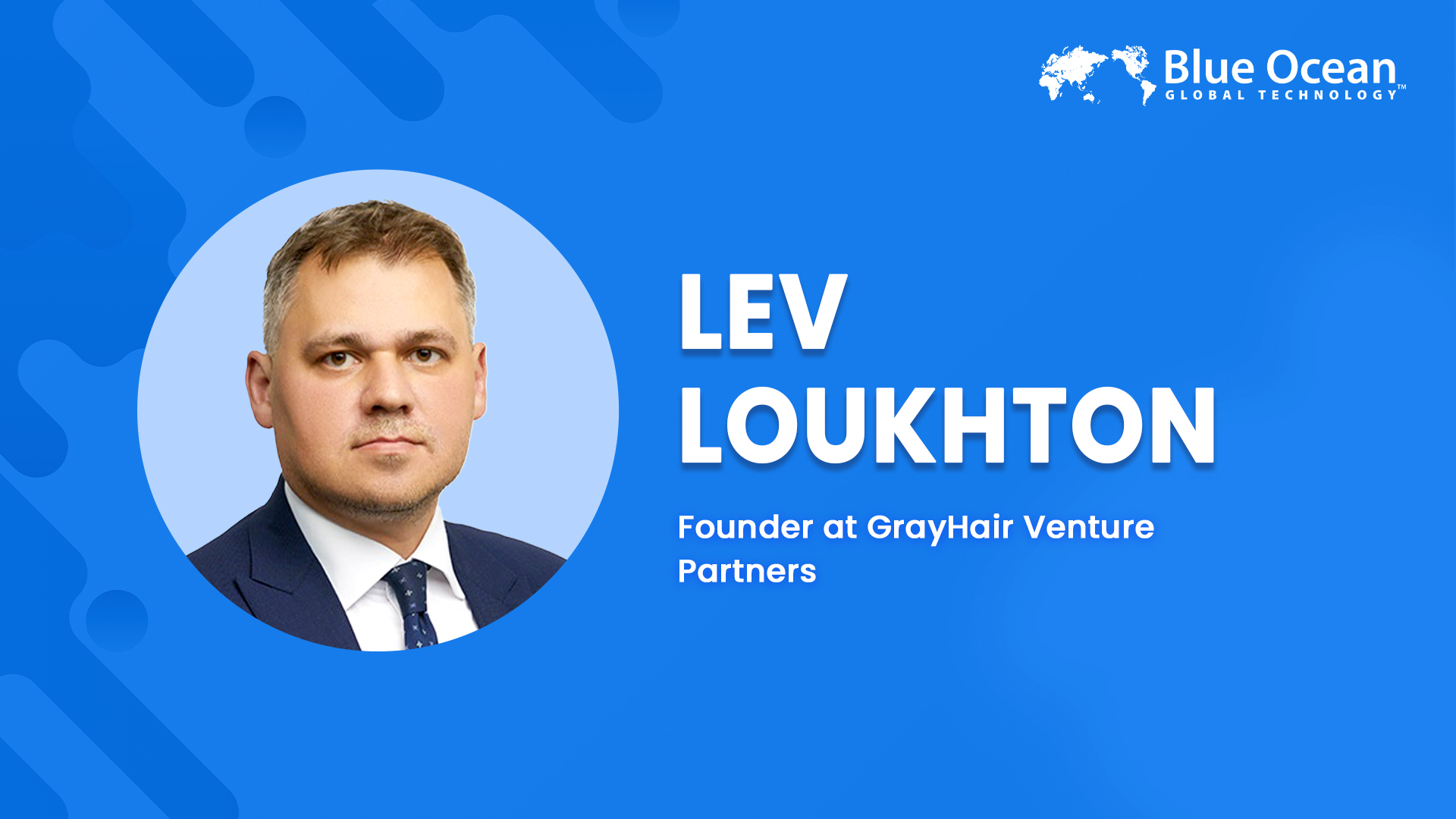
About Lev Loukhton:

Lev Loukhton built his early career as an M&A lawyer at Sullivan & Cromwell and Linklaters, drawn to the profession by a combination of interests that do not always sit together comfortably: a historian’s love of liberal arts and an inveterate quant’s fascination with math, physics, and chemistry. Law let him write extensively while also gaining a deep, practical understanding of how businesses actually make money, and he spent years structuring transactions and identifying risks outside the four corners of an agreement.
That legal grounding eventually led him into venture capital, where he now works as Founder of GrayHair Venture Partners. He runs a concentrated investment strategy, underwriting a small fraction of the legal tech startups his team evaluates, and spends his time speaking with founders, vendors, service providers, limited partners, and other participants across the legal technology and broader venture ecosystem. He is also active in public debate around venture investing and artificial intelligence, including ongoing discussions with UK-based thinker Quentin Solt.
Outside of investing, Lev describes himself as a historian at heart, drawn to anything that has endured long enough to become a lasting part of civilization, from old cities and architecture to enduring institutions like the Roman aqueducts. He reads widely and still plays chess, a childhood pastime that has stayed with him.
Blue Ocean: Tell us about your professional journey. What inspired you to pursue a career in law and eventually transition into venture investing, and what continues to fuel your passion for your work today?
Lev: I was trying to reconcile two parts of my nature that do not always fit together naturally. I am a historian who loves liberal arts, but I am also an inveterate quant who loves economics, math, physics, and chemistry. Becoming an M&A lawyer let me write a great deal while also forcing me to understand how businesses actually make money, and that combination is ultimately what brought me to venture. What keeps me here today is the same thing that dr

Blue Ocean: What does a typical day look like for you as a General Partner, and how do you balance evaluating opportunities, working with founders, and your broader responsibilities?
Lev: There really isn’t a typical day. I spend my job finding things interesting enough to obliterate my schedule, whether that means talking to founders, vendors, service providers, limited partners, or people across the legal tech world. I genuinely never know what will become the most important thing I am working on the following week, since an interesting startup can appear out of nowhere through an introduction or a cold outreach on LinkedIn. That unpredictability is very different from my time at a law firm, but I would not trade it for anything.
Blue Ocean: Which emerging trends in venture capital, entrepreneurship, and technology most excite you, particularly those that could shape the way businesses and investors create value?
Lev: What excites me most about AI is not that it saves twenty minutes here or there; it is that it makes entire workflows possible that were simply not economically feasible before– we call this part of our thesis the Legal Capability Frontier. Intelligence itself is becoming remarkably cheap, and the real question is how we reconstruct workflows once we account for everything that is now possible. The pace of change is equally exciting. Developments I assumed were five or ten years away when I started investing in this space are already here, and we are actively investing in companies building around them right now.
Blue Ocean: Can you walk us through a particularly challenging investment or business matter you’ve handled and explain your approach to navigating it?
Lev: I would rather describe the skill set than a single situation, because the hardest decisions are rarely about whether something is good. You usually already know an opportunity is worthwhile; what you don’t know is whether that worthwhile idea will actually turn out great. The key is understanding how much uncertainty you are prepared to own, which is less about risk management in the traditional sense and more about being honest with yourself about what you know and don’t know about a given opportunity. You can never eliminate uncertainty, but if you have gone through the proper process of reducing it, you can arrive at a conclusion you are comfortable standing behind, even knowing it could still be wrong.
Blue Ocean: You’ve built experience across law and venture investing. How do you continue to stay ahead in an increasingly competitive and rapidly evolving investment landscape?
Lev: I am not sure “staying ahead” is a claim I would make confidently in an environment that changes this quickly, but my approach is to assume that whatever I believe today is likely wrong about something, then look for the evidence of what it actually is. Many investors operate from the opposite premise, searching for evidence that confirms their existing thesis. I think that the habit of looking for what challenges my assumptions comes directly from my legal training, and it is what keeps me from falling behind, even if it doesn’t guarantee I am ahead.
Blue Ocean: What core values or principles do you believe every great investor and business leader should uphold, regardless of their industry or area of expertise?
Lev: Integrity, in the sense of intellectual honesty. You have to be willing to admit you are wrong and to kill your own thesis before the market does it for you. I see the same challenge play out constantly with founders who are so enamored with the problem they are solving that they stop hearing what the market is actually telling them. Outside information has to be allowed in, or the signal is lost before it ever reaches you. That openness to being corrected is probably the single most important value anyone in business, or frankly in any field, should hold onto.

Blue Ocean: What are some common misconceptions people have about venture capital, investing, or the process of evaluating emerging businesses?
Lev: The biggest one is that venture investing is about predicting the future. In reality, you are making decisions with an almost comically incomplete set of facts, and the best investors treat their vision of the future as something that evolves constantly rather than something fixed. There is a kind of reflexivity to it: what you tell the market affects what the market tells you back. The second misconception, usually on the founder side, is the assumption that venture capital exists to back almost any startup. It doesn’t. Venture is a peculiar type of capital suited to a small percentage of businesses, and plenty of founders with genuinely good ideas would be better served building a strong lifestyle business than chasing a raise simply because it feels expected.
Blue Ocean: What distinct value does your legal background bring to your work as a General Partner, particularly when evaluating complex opportunities, risks, or business structures?
Lev: Being a lawyer taught me to look for what isn’t on the page. Junior lawyers are trained to react to the text in front of them, but it takes real experience to notice what has been left out entirely. Sometimes that gap is the existential risk that threatens an entire deal, simply because nobody thought to write it down. As an M&A lawyer, I spent my career looking for the eventualities nobody else had considered, while also learning where to draw the line before that instinct turns into over-lawyering. I see the same dynamic in venture today. There is a consensus view that AI will be transformative, and it likely will be; still, the real question is what we are not seeing yet, whether that is a regulatory shift, a new technology, or some major misstep that changes public perception entirely.

Blue Ocean: How do you maintain objectivity and resilience when making high-stakes decisions, particularly when an investment involves significant uncertainty or competing considerations?
Lev: You cannot eliminate uncertainty; you can only make sure you are not fooling yourself about how much of it remains. I separate being wrong from losing money, since being wrong is inevitable in venture and part of placing any bet. We run a concentrated strategy, underwriting roughly one company out of every two hundred we screen, which is itself a source of resilience because it forces real selectivity. Objectivity comes from staying open to people I disagree with. I take part in public debate on LinkedIn with a UK-based thinker named Quentin Solt, whose views often differ sharply from mine, and those conversations consistently challenge my assumptions in ways I value.

Blue Ocean: What advice would you offer to aspiring entrepreneurs, investors, or young professionals who are looking to build a career at the intersection of law, business, and venture capital?
Lev: I will be a little contrarian here. Everyone is told to build a personal brand, and I agree that matters, but I would tell people to develop a genuine point of view before they develop a persona. I see too many people posting generic, often AI-generated content simply to maintain a presence. In a world full of that kind of noise, a truly original voice becomes far more valuable, not less. My second piece of advice is about optionality. The traditional linear career path, where you spend years slowly earning more responsibility, no longer really exists, especially as AI makes basic tasks in law, business, and accounting cheaper and faster to automate. Stay intentional about what marketable skills you build at every step, regardless of whether you stay in that organization long term.
Blue Ocean: What hobbies or interests do you enjoy outside of investing and your professional work?
Lev: I am a historian at heart, so I am drawn to anything that has survived long enough to become an enduring part of civilization, whether that is history, music, architecture, or old cities and cultures. I have a particular weakness for things older than me that still work, like a Roman aqueduct or Prague’s astronomical clock. I read a great deal, and I still play chess occasionally, though not with the intensity I had as a kid.
Blue Ocean: Is there a guiding principle, philosophy, or quote that has significantly influenced your career and life?
Lev: Staying curious. Curiosity is more valuable to me than certainty, because certainty closes doors; it gives you the false sense that you already know everything worth knowing. Staying curious means constantly asking what you don’t know yet, and being willing to seek out people and sources you disagree with rather than retreating into an echo chamber, something I see happening across business, politics, and social media alike. I think avoiding people with different backgrounds and viewpoints is genuinely dangerous, and that belief has shaped how I approach both my career and my life.
Conclusion
Lev Loukhton’s path from M&A law to venture capital reflects a consistent discipline of questioning his own certainty before the market does it for him. That habit shapes how he evaluates founders, debates ideas publicly, and advises the next generation of investors and entrepreneurs. His central message is that genuine curiosity and intellectual honesty matter more than confidence, and that a career built on a real point of view will always outlast one built on a persona.
Do you have a personal or professional story that can inspire other people into becoming the best version of themselves?
You are welcome to share your journey with our audience.