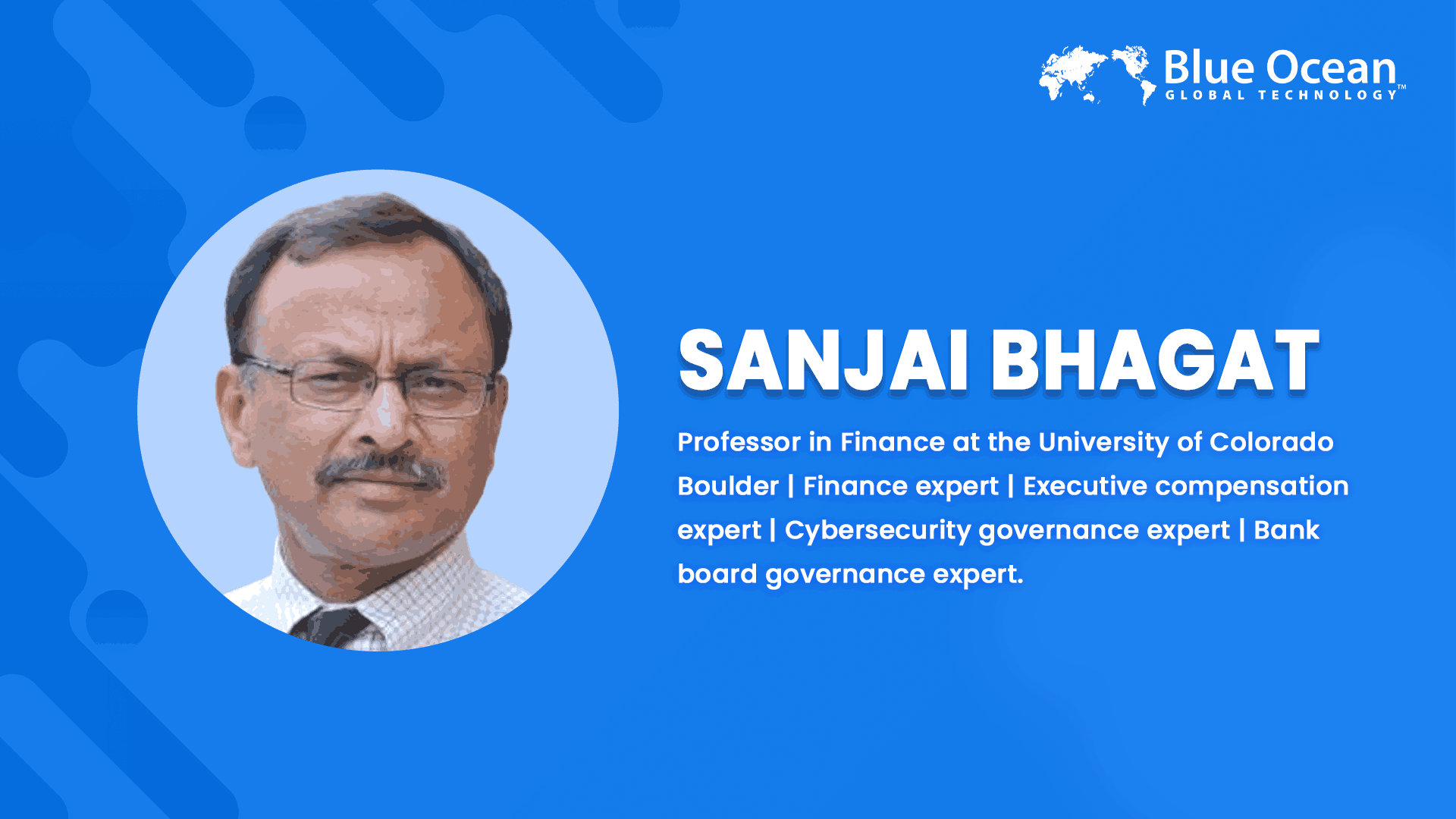
About Sanjai Bhagat

Sanjai Bhagat, PhD, serves on corporate boards. He is a qualified finance expert, executive compensation expert, cybersecurity governance expert, and bank board governance expert. He has been designated as a Director to Watch. He has published several very highly cited papers in corporate governance and corporate finance in top finance and law journals. He is the author of the critically acclaimed book, Financial Crisis, Corporate Governance, and Bank Capital.
Dr. Bhagat has advised the U.S. Securities and Exchange Commission and the U.S. Department of the Treasury on matters related to corporate governance and corporate finance. He has been invited to speak to groups of U.S. Court of Appeals judges, U.S. District Court judges, and state Solicitor Generals on appropriate measures of corporate governance and bank governance, as well as the impact of bank governance on bank performance. Dr. Bhagat has served as an expert in litigation involving economic damages to shareholders, value of reputation, value of intellectual property, IPO valuation, executive compensation, duty of care, and duty of loyalty.
Blue Ocean: Could you tell us about your professional journey—what inspired you to pursue a career in finance and corporate governance, and what continues to drive your passion for these areas today?
Sanjai Bhagat: My journey into finance and corporate governance began during my MBA at the University of Rochester. At the time, the university had a brilliant scholar, Michael Jensen, who, along with Bill Meckling, wrote the paper Agency Costs and the Theory of the Firm. That work had a strong influence on how I began to think about corporations, incentives, and economic value creation.
When I arrived at Rochester, I had almost no background in economics, business, or finance. My undergraduate training was in engineering, which was very different. I was also in a new country, trying to figure out what direction to take. Rochester happened to have one of the top finance departments in the world at the time, so I decided to leverage the institution’s strength and focus on finance. In many ways, the decision was accidental rather than carefully planned.
After completing my MBA, I moved to the University of Washington in Seattle to pursue my PhD. Much of my doctoral work and subsequent research was shaped by the economics and finance foundation I developed at the University of Rochester. Because I entered the field with a clean intellectual slate, I was able to learn the fundamentals easily and build my understanding from the ground up.
What continues to motivate me is the ability to think clearly about complex issues and explain them in a way that makes sense. Ideas matter more than titles or recognition. For me, the purpose of working in finance and corporate governance is to contribute, in some way, to improving human lives. If your work cannot be clearly connected to that goal, then it is worth reconsidering your priorities and direction.
Blue Ocean: What does a typical day in your life look like?
Sanjai Bhagat: I usually wake up fairly early by most standards. A day in the life sounds a bit like that Beatles song, which I’m sure you’ve heard. I start my day with about an hour to an hour and a half of different types of exercise. I focus a lot on flexibility, which is good for overall health and also helps my golf game, which I’ll come back to later.
A big part of that flexibility comes from exercises that are essentially yoga-based. In India, yoga has long emphasized keeping the body flexible, and that turns out to be incredibly important for long-term health. Even if someone is not a golfer, stretching and flexibility exercises make a real difference. Many trainers in places like Brazil or the U.S. may not call it yoga, but the exercises they teach are often derived from it.
In addition to stretching, I do other forms of exercise and try to get outside whenever possible. I’m fortunate to live in Colorado, where I can usually get fresh air, whether that means biking or taking a brisk walk. Even in winter, with snow on the ground, I still try to get outside for a quick walk.
Today is one of those rare late-December days in Colorado when it’s sunny, warm, and calm. Frankly, I usually like to play golf on days like these; however, I find myself in the office today, focusing on completing my work. That’s generally how my day begins.

Blue Ocean: As an experienced expert witness, what advice would you have for someone serving in this role for the first time?
Sanjai Bhagat: The first thing I would say is that, as an expert witness, you usually either write an expert report or, in some cases, the attorney may ask you not to write one and instead have your arguments clearly organized in your mind. Either way, the most important rule is that you must have a clear and thorough understanding of what you wrote and why you wrote it.
Often, several months pass between writing a report and giving a deposition or testifying at trial. When that happens, you must be able to recall your report in detail and explain the reasoning behind it. Sometimes an expert report does not include every detail of the argument, so when you are questioned, you need to be able to go back into the details and explain exactly what you did and why.
One important piece of advice I give to academic colleagues who want to serve as expert witnesses is to remember that depositions and trials are not academic seminars. In academia, when someone asks a question, it is common to answer that question and then provide additional context or information to help explain the broader picture. As an expert witness, you should not do that.
You listen carefully to the question and answer only what is asked, nothing more and nothing less. You are not there to educate the other side or explain finance or economics theory beyond the scope of the question. It is their responsibility to ask the right questions. Some questions may require longer answers, and that is fine, but your responses should be precise, accurate, and focused. Once you answer, you stop and let them ask the next question.
I also think expert witness work is intellectually stimulating and challenging. No two cases are alike. In my work, which focuses on finance, corporate law, and economic issues, the challenge is connecting academic knowledge to the specific facts of a case. Lawyers understand the legal framework, and my role is to identify where my economics and finance expertise applies, connect the dots, and explain those ideas clearly.
Being able to explain complex concepts to judges, juries, and attorneys in a way they can understand is where the real expert work happens. That process is demanding, but it is also very rewarding.
Blue Ocean: What are the core principles that animate your work in financial economics and corporate governance?
Sanjai Bhagat: At the core of my work in financial economics is corporate governance. Corporate governance is the set of processes that ensure outside investors receive a fair return on their investment. While that may sound technical, it explains why investors across the world are willing to put large amounts of money into companies whose managers they may not know and whose offices they may never visit.
Investors buy shares with the expectation that those shares will increase in value over time. Once their money goes into a company, the key question becomes what checks and balances exist to make sure those funds are used in financially sound ways. Good corporate governance guides managers to invest in projects that create products and services customers want, generate revenue and earnings, and ultimately increase shareholder value.
When this system works well, it benefits far more than investors alone. Customers receive better goods and services, companies create jobs, and innovation improves everyday life. Many of the technologies people now take for granted exist because companies were able to access capital and invest in long-term research and development.
One area where this impact is especially clear is energy. Access to cheap and reliable energy significantly improves human welfare, particularly in the lower-income strata of society. Research shows a strong relationship between energy use and measures of life expectancy, infant mortality, and income. Simple access to electricity or gas can dramatically improve health, living conditions, and daily life.
Corporations play a central role in providing this access. Whether privately or publicly held, companies rely on investment and effective governance to operate efficiently. A well-functioning corporate governance system allows firms to attract capital from around the world and ensures managers use those resources responsibly.
Ultimately, what animates my work is the understanding that corporate governance is not just a financial or legal concept. It directly shapes how capital is allocated, how jobs are created, and how lives are improved across the globe.
Blue Ocean: Of all the papers you have written, which do you think is the most important and why?
Sanjai Bhagat: The paper I consider most important is one I wrote in 2008 on corporate governance and firm performance. The paper examined the link between a company’s governance structure and its financial performance.
Financial performance is closely related to how customers view a company. If customers like a company’s products and services, they buy more. That increases revenue and earnings, and the share price performs better. Financial performance is essentially a shorthand for how well a company is doing its job of providing goods and services at an attractive price.
Our goal was to study the relationship between corporate governance and company performance. A major challenge was how to measure corporate governance. At the time, commercial vendors provided proprietary governance indices that rated companies as well governed or poorly governed. These vendors would not disclose how many variables they used, how those variables were measured, or how they were weighted.
Despite being skeptical, we accepted their indices as given and tested whether companies rated as well governed performed better financially. We found no correlation between the vendors’ governance indices and company performance. In some cases, the relationship was actually reversed, where companies labeled as well governed performed worse than those labeled poorly governed.
Rather than only criticizing existing measures, we proposed a new governance measure based on director ownership. Directors are elected by shareholders and are responsible for hiring, advising, and monitoring the CEO. We argued that directors should have meaningful stock ownership in the companies on whose boards they serve. When directors have skin in the game, they pay closer attention because their compensation depends on the value of the stock.
We tested this idea empirically and found a significant positive relationship between director ownership and firm performance. Other researchers replicated this finding in different contexts and in other countries. The paper has had a substantial impact, won multiple awards, and continues to be widely cited. Its core idea is straightforward. When people have skin in the game, they pay more attention.
Another important paper I wrote looks at a more fundamental question of why some countries achieve economic prosperity while others do not. In that work, published in the Harvard Business Law Review, I examined the relation between economic prosperity (GDP per capita) and the rule of law in over 130 countries during the past three decades.
By rule of law, I mean the protection of private property rights, personal safety, and the enforcement of legal contracts. When citizens know their property will not be expropriated, their physical safety will be protected, and contracts will be enforced fairly by courts, economic prosperity follows. If a country can provide these basic foundations, many positive outcomes (like greater economic prosperity and less income inequality) emerge naturally. Without them, no amount of external expert economic advice or expert intervention will succeed.
Those two papers together reflect the core of my work, one focused on firm-level governance and performance, and the other on the institutional foundations of economic prosperity around the globe.

Blue Ocean: What do you find most rewarding about your role as an educator, especially when helping students connect complex financial theories to real-world challenges?
Sanjai Bhagat: What I find most rewarding is helping students see how financial theory connects to real outcomes in the world and, ultimately, to improvements in human lives. My work spans a wide range of areas within finance, from executive compensation and corporate governance to equity issuance. More recently, I have focused on understanding which economic policies, business policies, and financial strategies actually lead to better business and financial outcomes, and then showing how those outcomes translate into tangible improvements in people’s lives, not just in the United States but across the globe.
For me, the underlying theme is impact. The ideas we spend time on and the intellectual energy we apply should, at some level, improve the lives of the average person. When I teach, I want students to understand that finance is not just about models or metrics in isolation. It is about creating structures that allow businesses to function, economies to grow, and people to move out of poverty and into more secure and dignified lives.
I often illustrate this by contrasting small, well-intentioned interventions with broader institutional changes. Improving the lives of even a few people is meaningful, but history shows that the largest and most sustained improvements in human welfare come when countries strengthen basic institutions, especially private property rights, enforcement of legal contracts, and physical security. China after the early 1970s and India after the early 1990s are clear examples. In both cases, giving people the freedom to own property, start businesses, and rely on courts to enforce legal contracts led to dramatic economic growth and lifted hundreds of millions of people out of poverty. That scale of improvement has no parallels in human history.
I also emphasize that this progress is not guaranteed. The example of Venezuela (up until December 2025) shows how quickly living standards can collapse when the rule of law breaks down, and property rights are no longer respected. These comparisons help students understand why governance, legal institutions, and financial systems matter so deeply.
When students grasp these connections and see that finance, governance, and the rule of law are directly linked to human well-being, that is the most rewarding part of teaching for me. It means they are not just learning theory, but understanding why it matters and how it can be used responsibly to improve lives.

Blue Ocean: In your experience, what qualities separate those who excel in their field from those who don’t?
Sanjai Bhagat: The idea of excellence has been discussed by people ranging from Aristotle to Michael Jordan, and they all say essentially the same thing. “Excellence is never an accident. It starts with having a very high level of motivation or very ambitious objectives.”
But it is not enough to simply have high goals. You also have to put in place a determined and focused effort to execute what is required to accomplish those objectives. First, you set high goals, and then you commit to a disciplined effort to achieve them.
Michael Jordan, who many consider to be the best basketball player the world has ever seen, often talked about this idea. He emphasized that excellence is not something you achieve in a single day or even a single year. It is something constant in your life. Every day, in everything you do and think about, you are focused on how you can do things better and how you can improve.
Blue Ocean: You’ve mentored countless students and professionals. How do you approach guiding those who look up to you and aspire to make an impact in economics and policy?
Sanjai Bhagat: When guiding students, I usually start by telling them that they have to get the basics right. That means doing their coursework properly, and if they are at the research level, focusing seriously on their research.
What exactly that coursework should emphasize has changed over time. Earlier, I would focus heavily on areas like econometrics or statistics, which are still important. But now, I also emphasize areas related to natural language programming and AI more generally. AI has become an important part of the field, so the question becomes how to integrate AI into finance, economic research, or professional work.
Depending on the time period, you have to think about what will be valuable for their careers and try to guide them accordingly. I advise a wide range of people, from high school students to professors at top universities, and senior business executives. Of course, the guidance varies depending on the context.
Overall, I try to look at where the world is and where it is going, and what will be in the best interest of the individual I am speaking with. Today, some aspect of AI has to be incorporated, or at least people need to be aware that they should think about how AI might fit into what they are doing. I do not have all the answers, but I try to make them aware of this question.
Blue Ocean: What is something you are most grateful for, either professionally or personally?
Sanjai Bhagat: That is an easy one. I am most grateful for the accomplishments of my children. I have two sons, and they do very different things. When they accomplish something, whether big or small, that is very meaningful to me.
I am also grateful when I receive reassurance or feedback from colleagues or others that the intellectual ideas I have contributed, such as those related to the rule of law, are actually relevant and are improving people’s lives. That is very important to me and deeply satisfying.

Blue Ocean: What’s one lesson in life that changed your perspective?
Sanjai Bhagat: One lesson that changed my perspective goes back to the idea of excellence. It is not enough to have high objectives. You have to be dedicated to carrying them out on a day-to-day and hour-by-hour basis. Excellence has to be an ongoing commitment.
I have also found that most successful individuals, whether in business, politics, athletics, or academics, tend to pursue excellence across multiple aspects of their lives. While one area may stand out the most, they usually strive to do well in everything they are involved in. That way of thinking shapes how they approach life overall.
Conclusion
Professor Sanjai Bhagat reflects on his journey in finance and corporate governance, emphasizing clear thinking, disciplined execution, strong institutions, and the rule of law as foundations for economic progress. He highlights how sound governance, ownership incentives, and excellence driven by daily commitment can improve businesses, educate future leaders, and meaningfully enhance human lives across the globe.
Do you have a personal or professional story that can inspire other people into becoming the best version of themselves?
You are welcome to share your journey with our audience.