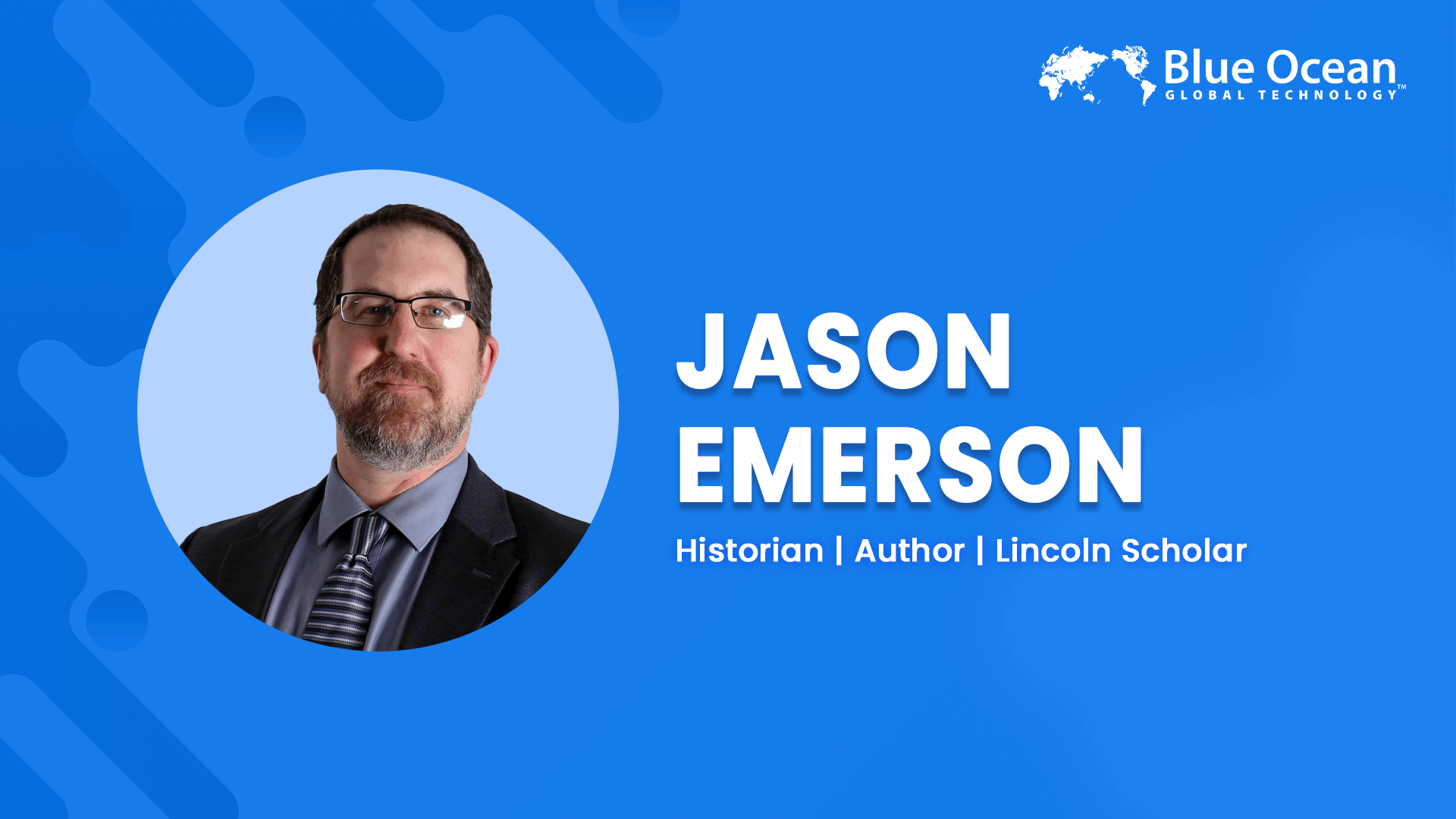
About Jason Emerson

Jason Emerson is an award-winning Lincoln scholar and general historian. He is the author or editor of eight books and nearly fifty articles. He has appeared as a historical expert on multiple television and radio shows and podcasts, and has lectured around the country from the Library of Congress to the Florida State Book Fair to the Lincoln Shrine in Redlands, California, and everywhere in between. Jason is currently compiling the collected letters of Mary Lincoln. If you know of any original Mary Lincoln manuscripts that are unpublished or otherwise unknown, please contact him. Visit his website at www.jasonemersonhistorian.com.
Blue Ocean: Your career as an award-winning Lincoln scholar and historian is marked by both depth and originality. What drew you to Lincoln studies, and how did that interest shape the direction of your research and writing?
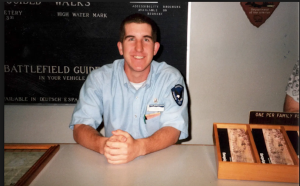
Jason: During my college years, I applied for the Student Conservation Association, which offered paid internships with the National Park Service. I spent three months at the Lincoln Home, where I performed the same duties as a park ranger, just under a different title, and I absolutely loved the work. The following season, I was hired at Gettysburg National Military Park, where the Civil War and Lincoln’s legacy were central to the site’s mission.
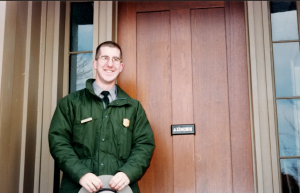
The following year, I applied once more and was hired as an official National Park Service ranger at the Lincoln Home. It was a wonderful and formative experience.
My undergraduate degree is in literature and writing. I also loved history, though I had not yet connected the two. While working at Lincoln’s home, I spent countless hours reading and researching. I published two articles on Abraham Lincoln in academic journals. From that point forward, it never stopped. I have continued writing, reading, and studying Lincoln, his family, and the Civil War.
Blue Ocean: With eight books, nearly fifty published articles, and frequent media appearances, how do you structure your day to balance research, writing, and public engagement?
Jason: One of the advantages of working from home is flexibility, though I try to follow a routine. Usually, my day starts with coffee at 8 am until about 5 pm. Sometimes I take an afternoon off and return to work later in the evening, or I’ll start working as early as 5 a.m. and finish earlier in the day.
When I’m working on a project, I tend to become deeply immersed—sometimes even a bit obsessive—so I often push through whatever I’m focused on. It can be difficult to step away once I’m in that mindset. Right now, I’m working on a book about the collected letters of Mary Lincoln, along with several articles I’ve started and want to complete. I also have a second book in progress. Balancing these projects can be challenging.
To manage that, I rely on structure. I’ll designate an entire day to a specific article, and then return to book work afterward. If the second book moves forward, and I’m fortunate enough to secure a contract, I’ll be juggling two books at once. In that case, I may split my days between them or alternate projects every other day.
Blue Ocean: Your discoveries, particularly the recovery of Mary Lincoln’s long-lost letters, have reshaped parts of the historical record. Can you walk us through the moment you realized the significance of that finding?
Jason: The letters had been missing for more than eighty years and were widely known among Lincoln scholars as a historical mystery. Written by Mary Lincoln to her close friend Myra Bradwell during her confinement in a sanitarium, the letters were the subject of speculation for decades. Many believed they had been destroyed by Mary or her son Robert, while others doubted they existed at all. Despite repeated efforts by historians, no one had been able to locate them.
While researching a biography of Robert Todd Lincoln at Hildene in Manchester, Vermont, I discovered references to Mary Lincoln’s missing letters. Given my prior research on Mary Lincoln’s insanity case and familiarity with the historiography, I immediately recognized the importance of these references.
Although only two such references were found at Hildene and no other Lincoln archives held the letters, the discovery prompted a shift in strategy. I turned my attention to Myra Bradwell’s family and located her last living relative. While the letters were not in his possession, I provided related correspondence revealing a complex legal dispute between the Bradwell and Lincoln families over ownership and publication rights, suggesting why the letters had remained hidden for so long.
The legal dimension led me to investigate the families of Robert Lincoln’s longtime attorneys. One family declined to participate, but another revealed the existence of a long-forgotten steamer trunk in their attic. Inside were the missing letters, legal documents tied to the dispute, and an unpublished manuscript based on the correspondence that had been deliberately suppressed by the Lincoln family. This final discovery allowed me to reconstruct the complete story.
Recognizing the historical significance of the find, I paused my work on Robert Lincoln to write a new book focused on Mary Lincoln’s insanity case and the recovery of the letters. That book, The Madness of Mary Lincoln, became both my favorite and best-selling work.
Blue Ocean: You remain the only scholar to have comprehensively studied Robert T. Lincoln. What compelled you to focus on a figure so long overlooked, and what did that work reveal that surprised you most?
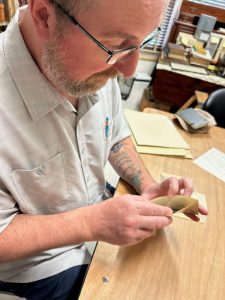
Jason: As a Lincoln scholar, I am motivated by a desire to explore subjects that have not already been exhaustively examined. This philosophy took shape during my time as a ranger at the Lincoln Home, where extensive reading led me to Mary Lincoln’s insanity episode. Around the same time, a visit to Robert Todd Lincoln’s home, Hildene, sparked a deeper interest in Robert himself.
The only existing biography of Robert dates back to the 1960s and was limited by the family’s refusal to share materials, leaving significant gaps in understanding a figure I found both overlooked and compelling.
My work is grounded in the belief that historical figures cannot be fully understood in isolation. Family relationships, marriages, children, and personal struggles are essential to understanding a person’s character and motivation. From this perspective, Mary Lincoln and Robert Lincoln are indispensable to understanding Abraham Lincoln as a husband, father, and human being, and not just as a political icon.
As research into Robert Lincoln deepened, I uncovered remarkable and largely unknown episodes, including repeated efforts by the Republican Party to recruit Robert as a presidential candidate and an extraordinary incident in which Robert’s life was saved by Edwin Booth, the brother of Abraham Lincoln’s assassin. These discoveries, published first as articles, convinced me that Robert’s life warranted a comprehensive, modern biography.
Writing that biography proved transformative. Robert Lincoln’s long life intersected with nearly every major political, diplomatic, and economic development of his era, offering fresh insight not only into his own career but also into American history more broadly.
Blue Ocean: Two of your books have been named Book of the Year by the Illinois State Historical Society. What do you believe has been the key to producing work that resonates so strongly with both scholars and the public?
Jason: The stories I focus on are unique and often filled with facts and issues that haven’t been explored or read before. I practised journalism for over twenty years. History, at least initially, was something I pursued alongside that work. Because of that background, I know how to write—and how to tell a story.
Everyone likes to think they’re good at what they do, but one consistent theme in the reviews of my books has been their readability. Readers and reviewers frequently comment on how well written they are and how engaging the narratives are. I think that makes a real difference.
When I was in college, I actually tried to major in history, but it didn’t resonate with me at the time. The lectures felt dry, the books were uninspiring, and the focus was largely on memorizing names and dates rather than exploring compelling people, pivotal events, and why they matter.
I like to think my books have found an audience because they approach history differently by emphasizing storytelling, context, and meaning. Readers don’t just learn what happened; they experience the lives and moments that shaped it. That combination of solid research and engaging narrative is what I believe makes the work both accessible and exciting to read.
Blue Ocean: As a historian frequently featured on television, radio, and podcasts, how do you approach translating complex historical research for broader audiences without sacrificing scholarly rigor?
Jason: That balance can be challenging. I care deeply about scholarly rigor and transparency. All of my books have been published by university presses, and they are thoroughly documented with endnotes, citations, and footnotes. I want readers to know exactly where my information comes from. I’ve read far too many history books where a claim feels questionable or is incorrect.
I never want my work to fall into that category. At the same time, extensive documentation can be intimidating. A heavily footnoted book can turn some readers away because they assume it’s going to read like a graduate-level textbook.
Being a good speaker matters. I’ve encountered scholars whose books are outstanding, but they struggle to engage an audience in person. If you’re not interesting, enthusiastic, and accessible, people simply won’t want to listen. I believe it’s possible to maintain rigorous scholarship while framing it in a way that feels inviting and engaging.
A big part of that is knowing your audience. At a Lincoln conference, for example, people love the minutiae—they want every detail. In a different setting, such as a book festival or a general public talk, audiences are more interested in the broader narrative and the compelling stories. Connecting with them means adjusting your approach without sacrificing accuracy.
As the editor of a community newspaper, I learned that it’s not just about what you write, but how you present it. You have to understand what people want to read, what they want to hear, and how they engage with information. You can be the best scholar in the world, but if you can’t make your work interesting, no one will read it—and then what’s the point?
Blue Ocean: From the Library of Congress to national book fairs and historic shrines, what have you learned from engaging with such diverse audiences across the country?
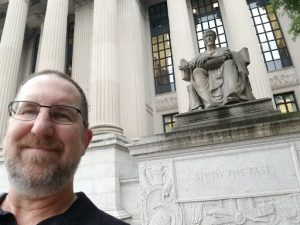
Jason: Learning what people are genuinely interested in is essential, and one of the best ways to do that is through questions. I actually love the question-and-answer portion after a talk. You can never address everything in a single presentation, but the questions reveal what people truly want to know. After giving a few talks, when you hear the same questions repeatedly, you quickly learn which issues consistently resonate and which topics you need to be prepared to address in greater depth.
It’s about listening and paying attention to what people bring up in conversations at conferences, lectures, and events. They tell you, often very clearly, what interests them. That’s one of the reasons Mary Lincoln’s insanity case remains so compelling and widely discussed: people are deeply interested in it.
Mary Lincoln’s mental health is central to understanding who she was. Mental illness shapes every aspect of a person’s life, both positively and negatively, and it isn’t something that can be ignored without distorting the historical record.
Some people who admire Mary Lincoln and believe she was treated unfairly—or was a victim of a male-dominated society—are understandably uncomfortable discussing her mental health. But if that’s what audiences want to explore, and if it’s essential to understanding her life, then it has to be addressed. Leaving it out, whether because it’s uncomfortable or controversial, means leaving out a significant part of the story. You can’t claim to tell a complete history while omitting something so fundamental.
Engaging with audiences does more than reveal what they care about—it also challenges the historian. I’ve been asked many questions that approached a topic from an angle I hadn’t previously considered. Those moments force you to rethink, refine, and sometimes recalibrate your interpretation.

Blue Ocean: In your view, what qualities distinguish historians who make lasting contributions to the field from those whose work fades over time?
Jason: There are three essential elements. First, you have to be a good writer. If the writing isn’t engaging, people simply won’t read the work, no matter how strong the research is.
Second, you have to be a solid scholar. I firmly believe in doing my own research. I want to work directly with the sources myself. Scholarly rigor is nonnegotiable. I’ve read too many history books with weak or nonexistent citations, or citations that don’t actually support the claims being made. When that happens, you can’t verify anything, and once doubt sets in, it undermines the entire book. Even worse, some works contain outright factual errors.
The third element is subject matter. I believe strongly in writing about topics that haven’t already been examined endlessly. It takes an exceptional scholar to revisit a subject that’s been written about thousands of times and still produce something original, meaningful, and enduring.
If you want your work to last, it either has to reach that extraordinary level or it has to be genuinely new and distinctive. Otherwise, it gets lost. In a field like Lincoln studies, where there are tens of thousands of books, simply being “good” isn’t enough. One good book disappears easily into a sea of other good books. To endure, a work has to stand apart.
Blue Ocean: How do you approach mentoring or advising younger historians who are inspired by your discoveries and your willingness to challenge long-standing assumptions?
Jason: I always encourage people to question everything and never accept someone else’s work at face value. Other scholars’ research can be incredibly useful, but it’s essential to verify everything yourself. Understand not only what an author is arguing, but where their information comes from, and then go back to the source material.
Today, that process is easier than ever. When I was a young historian, you had to travel to archives or request photocopies by phone or letter, and later by email. Now, a simple email request can yield scanned documents, and an extraordinary amount of primary material is available online for free. Given that access, there’s really no excuse not to consult sources directly.
Doing your own work from those sources is critical. Don’t be afraid to challenge prevailing interpretations or long-held conclusions. That’s how the field advances. If you’ve done the work thoroughly—if you know the sources, have read the existing scholarship, and are fully immersed in the material—there’s no reason to shy away from questioning accepted narratives.
When your conclusions are grounded in primary evidence, you can defend them with confidence. You won’t need to deflect questions, gloss over weaknesses, or feel uncertain in discussion. Instead, you’ll be able to engage critically and thoughtfully, supported by facts. That, ultimately, is what good history demands.
Blue Ocean: Looking back on your career, what advice would you give to your younger self at the start of your journey as a historian and author?
Jason: I’m very proud of my work and my career overall. All of my books have been published by university presses, and I value that deeply. Still, when I was first starting, my goal was different. I wanted to publish with commercial presses. I wanted my books on bookstore shelves, accessible to a broad audience, and I wanted to make a living as a writer, which, realistically, requires commercial success.
Looking back, the advice I would give my younger self is simple: slow down, do the research, and learn the business side of writing before rushing to publish. While I’ve achieved academic success, I didn’t achieve my original goal, largely because I didn’t know what I was doing yet.
The Madness of Mary Lincoln is a good example. For an academic book, it has sold extremely well, and the reviews were unanimous in their praise of its readability. Many described it as reading like a mystery novel or a work of narrative nonfiction rather than a traditional academic monograph. I agree—it’s a compelling story. Yet when I first pitched it, I was rejected by six publishers and six literary agents. I couldn’t understand why.
I even spoke with an editor at a Simon & Schuster imprint who was initially enthusiastic. But he ultimately told me he didn’t see it as a book—perhaps an academic project for a university press, or maybe even just an article. I heard variations of that response multiple times, and at the time, it made no sense to me.
Meanwhile, I was already under contract for my Robert Lincoln book with Southern Illinois University Press, which has now published five of my books. I asked them if they would be interested in the Mary Lincoln project, and they declined. I shopped it everywhere. No one wanted it.
But I knew I had to write that book immediately. The letters I had uncovered were now known to exist, and there were historians—especially then—who specialized in compiling and editing documents rather than writing narrative history. If I didn’t act quickly, someone else would. This was a major discovery, and I wasn’t going to let it slip away.
So I went back to my publisher and told them plainly: I was going to write this book regardless. Wouldn’t it benefit all of us if they published it? Reluctantly, they agreed. They weren’t happy at first, but they went forward with it.
I wrote the book in three months and turned it in. I’ll never forget the call from my editor. She told me everyone at the press was passing the manuscript around because they wanted to read it. She said it was completely different from what she had expected. I told her it was exactly what I had described in the proposal. She admitted she had assumed I would simply publish the letters with an introduction. I hadn’t. The proposal had clearly failed to convey my vision.
That realization hit hard. If I had written a stronger proposal—if I had understood how to frame the book properly—I likely would have secured an agent and a commercial publishing contract. My career might look very different now, twenty years later. That misstep was my responsibility. I was eager to be published, I thought I knew what I was doing, and I didn’t take the time to learn what I needed to learn.
In that sense, it was a significant failure. Sometimes I regret it; sometimes I don’t. Academic publishing gave me freedom, credibility, and the chance to pursue the work I care about most. Still, when I reflect on that early decision, it’s the one moment I would handle differently. It’s a difficult question to answer—but that initial mistake is the closest thing I have to an answer.

Blue Ocean: What aspect of your work are you most grateful for, professionally or personally?
Jason: In the simplest and most honest sense, if I hadn’t become a historian, I wouldn’t have my daughter, who is, without question, my life and my everything. I worked as a park ranger and later at a historic site near my home, and it was there that I met my first wife, who is my daughter’s mother. Without that path, my daughter wouldn’t be part of my life, and that alone makes everything else secondary.
Beyond that, the profession has given me a life I’m deeply grateful for. I’ve traveled across the country to research and speak, met extraordinary people, formed lasting friendships and professional relationships, and seen places I might never have experienced otherwise. Being able to do work that I truly love is a gift I never take for granted.
At the same time, writing has always been at the core of who I am. Ever since I was a child, I wanted to be a writer. When I was about five years old, I wrote stories and drew illustrations to go with them. I wrote fiction and poetry when I was younger and throughout college before ultimately turning to history.
What’s remained constant is my desire for my work to matter. I’ve always wanted my writing to touch people—to inspire them, to be useful, and to mean something beyond the moment. I’ve wanted to create work that might outlive me, something future generations could learn from or connect with.
I often think about Lincoln scholars whose work I admire deeply—people who have been gone for many years, whom I never met, yet whose scholarship continues to shape how we understand the past. Some were giants in their time; others are less widely known now, but their work remains extraordinary. That idea stays with me.
Ultimately, I hope my own work has that kind of longevity. I want it to last, to continue to speak to people after I’m gone. And I’m hopeful—I feel like I still have a great deal left to do, and many more stories yet to tell.
Blue Ocean: Outside of writing and research, what interests or activities help you maintain balance and perspective beyond work?
Jason: My family, first and foremost. My daughter is my best friend. I truly cherish the time we have together. My wife and I spend a great deal of time together—and we enjoy it. We do almost everything as a team.
I’m also very close to my father. We play golf together, go fishing, and spend a lot of time outdoors. My wife and I love board games, taking walks, being outside, and reading. I’m a big movie fan as well.
Beyond that, it’s really just about living well and appreciating the everyday moments. History is my passion, and my family is my foundation. I don’t have a long list of hobbies I pursue constantly, but what matters most to me is spending time with the people I love and enjoying the life we’ve built together.
Conclusion
Throughout his career, Jason has been guided by a commitment to original research, narrative clarity, and intellectual honesty. Rather than revisiting familiar ground, he has chosen to explore overlooked figures, forgotten documents, and underexamined episodes. His work demonstrates that rigorous scholarship and compelling storytelling are not opposing forces, but complementary ones. His goal is simple yet ambitious—to create work that endures, informs, and resonates beyond his lifetime. By combining careful research with engaging narratives, he continues to contribute meaningfully to historical scholarship while inviting new readers into the past.
Do you have a personal or professional story that can inspire other people into becoming the best version of themselves?
You are welcome to share your journey with our audience.