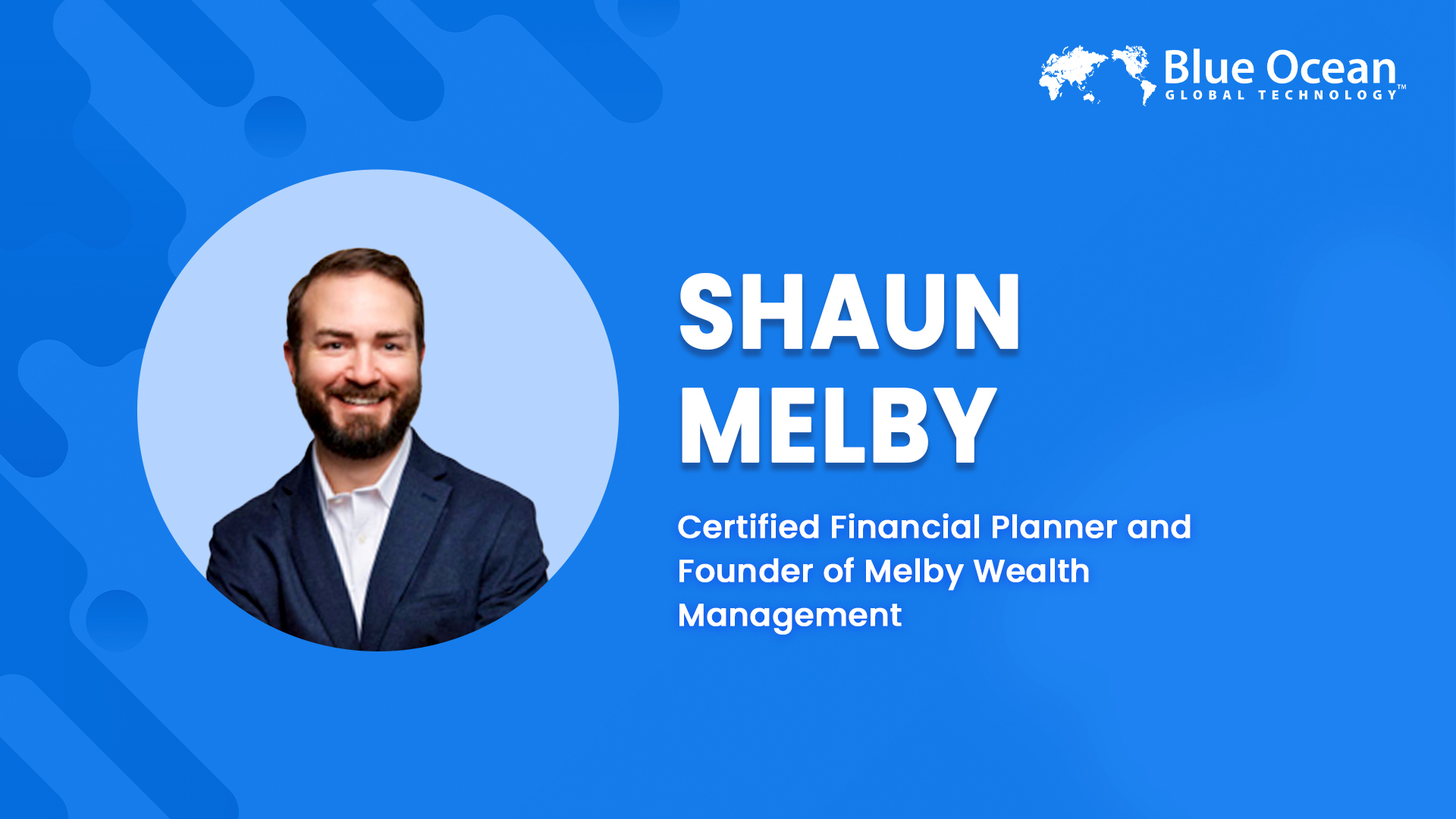
About Shaun Melby:

Shaun Melby is a CERTIFIED FINANCIAL PLANNER® (CFP®) professional and the founder of Melby Wealth Management, a fee-only fiduciary firm in Nashville, Tennessee. He is also the founder of AdvisorSEO Max, a SaaS platform that helps independent advisors compete in organic and AI search, and the creator of Melby Money, a personal finance education brand and podcast for millennials.
Shaun began his career in Nashville’s music industry, spending nearly a decade managing the finances of country music artists. He earned his CFP® certification in 2012, making him one of the youngest practitioners in the country at the time, and launched his own firm in 2019, growing primarily through organic search rather than paid marketing.
His perspective has been featured in CNBC, Bloomberg, Fortune, and The Wall Street Journal. He holds a BBA in Finance and Music Business from Belmont University and lives in Nashville with his wife and two children.
Blue Ocean: Tell us about your professional journey. What inspired you to pursue a career in financial services and later transition into entrepreneurship with Advisor SEO Max, and what continues to drive your passion for the profession today?
Shaun: I went to Belmont University in Nashville thinking I would pursue the creative side of the music industry. There’s an incredible amount of talent there, whether in performance, songwriting, or behind the scenes in the studio. I realized relatively quickly, though, that I didn’t quite have the chops to make a career on the creative side.
Around that same time, I took my first finance class. I remember the professor spending about 30 minutes explaining the time value of money and compound interest, working through all the calculations. When he finished, he turned to the class and asked, “All right, who has questions?” The way I remember it, every hand in the room went up except mine.
I looked around, and a light bulb went off. I thought, “Maybe I should look more closely at this finance thing. It seems to come naturally to me, and apparently it doesn’t come as easily to everyone else. Maybe there’s something there.”
So, I pivoted within the music business program to focus more on the business side of the industry and added finance as a second major.
I graduated in December 2008, which was probably the worst possible time to enter the job market in our lifetimes. As a good finance nerd, I kept track of every application I submitted: whether I heard back, whether I got an interview, how the interview went, and what I thought my chances were of receiving an offer. I sent out exactly 200 applications, got three interviews, and received two job offers. So, I was literally batting 1%. That’s how difficult the market was, and I had a strong résumé.
Fortunately, I landed a job doing exactly what I wanted to do. I became a business manager in the music and entertainment industry, handling finances for country artists, songwriters, executives, producers, and others. Essentially, if a dollar went out, it came through me. I handled accounting, taxes, and financial matters on both the personal and business sides, helping run those businesses from a numbers perspective.
I did that for 10 years and learned an incredible amount along the way. I sat for the CFP exam in July 2011, and after completing the required three years of work experience, I earned my CFP certification in 2012. So, by that point, financial planning has always been part of my professional background.
I’m also entrepreneurial by nature. I’m always looking for gaps in the market and asking, “What’s missing? Is there a service or solution that could address this?”
For example, while working as a business manager, I noticed that songs tended to follow similar patterns as they moved up the country radio charts. I thought that if you could identify early on which successful songs a new release was tracking similarly to, that information might help record labels or talent agencies make better decisions about where to allocate their resources.
So, I built a small algorithm to do exactly that. The challenge was simplifying the statistical information enough to make it easily digestible for people without a background in statistics. But that experience illustrates how my mind tends to work. I see patterns and start thinking about how they can be turned into something useful.
Around 2018, I started feeling an itch to focus more heavily on financial planning, although I wasn’t entirely sure how to make that transition. I stumbled across the Kitces Advisor Success Podcast and probably listened to around 100 episodes, sometimes more than once. I studied how other advisors had built their businesses, took extensive notes, and gradually figured out, “Okay, if I were going to do this, here’s how I would approach it.”
In 2018, I finally took the leap. I told my boss that I would be leaving in two months, at the end of the year, to go out on my own. Part of that decision was also about work-life balance. My wife and I wanted to start a family, and I wanted more control over my schedule.
Then, about a month after I told my boss I was leaving, we found out we were expecting our first child.
Nothing motivates you quite like finding out there’s a baby on the way while you’re preparing to start a business with zero clients.

Blue Ocean: What does a typical day look like as a financial advisor and entrepreneur? How do you balance serving clients with leading and growing Advisor SEO Max?
Shaun: I have different workflows that clients move through, so the first step in my day is usually checking my email inbox to see if any urgent issues need my attention. From there, I review my to-do list within those workflows and work through whatever needs to be completed.
I also schedule client meetings within specific blocks of time, which allows me to be intentional about balancing meetings with focused client work. As a solo advisor, I have to be very disciplined about how I manage my calendar and structure my day.
Advisor SEO Max fits into the time I have outside of client work and meetings. Whenever I have additional time, I focus on developing and growing that side of the business. Especially in the early stages, building it required a significant commitment. There were a lot of late nights and weekends spent working on it and getting it to where it is today.
Blue Ocean: Which emerging trends in the financial advisory industry do you find most significant, particularly those affecting client relationships, technology, and practice growth?
Shaun: A lot of people are discovering the RIA model and realizing, “There’s a different way of doing this,” rather than working within one of the big firms. I think more advisors are moving toward the independent channel for many of the same reasons I did.
I didn’t want someone else telling me how I needed to work with my clients. I had a very strong vision for how I wanted to help people and the kind of experience I wanted to provide, and I was determined to pursue that vision one way or another.

Blue Ocean: Can you walk us through a particularly challenging business or client engagement you’ve handled and explain the approach you used to achieve a successful outcome?
Shaun: It doesn’t happen often, but sometimes we work with clients whose expectations don’t quite align with their financial reality. They may have accumulated a certain amount of money and feel that it should support a particular lifestyle. The challenging conversation is explaining, “Based on the numbers, that lifestyle may not be sustainable.” Someone may think they can spend $20,000 a month when the reality is closer to $10,000, so we need to look at what that lifestyle actually looks like.
If I can have that conversation early in someone’s career, we have a lot more flexibility and time to make adjustments. If someone is on the cusp of retirement, it becomes a much more difficult conversation because there are fewer opportunities to change course.
I always approach these discussions without judgment. We would all love to have a higher standard of living than our financial reality might allow. My role is to help bring expectations back in line with the numbers while also showing clients what is still possible. It becomes a conversation of, “You can still do X, Y, and Z. It may just look a little different from what you originally envisioned.”
Blue Ocean: You have spent years helping financial advisors grow their practices through innovative digital strategies. How do you stay current with evolving industry trends, technology, marketing strategies, and client expectations?
Shaun: It’s constantly evolving, and I find that really exciting. I enjoy keeping up with new developments and thinking, “Here’s something new I can use to make the client experience even better.”
I also enjoy building small, customized tools around things I wish already existed in the market. I’ll identify something that could benefit the client while also streamlining my operations and think, “If I could create a tool that does this, it would make the entire process more efficient.” Then I’ll explore whether I can use AI to build an application or solution that accomplishes it.
It’s been incredibly fun and energizing to experiment with these technologies and be on the leading edge of what’s possible.
Blue Ocean: Having worked closely with financial advisors and built solutions designed specifically for the profession, what core principles do you believe every advisor should uphold when serving clients and growing their business?
Shaun: I often tell people, especially prospective and current clients, that being fee-only and acting as a fiduciary should be the baseline standard for financial advisors. Unfortunately, only a relatively small subset of advisors are fee-only and consistently held to the fiduciary standard. I wish every advisor were held to that same standard because clients deserve advice that is genuinely focused on their best interests.


Blue Ocean: What are some of the most common misconceptions people have about digital marketing and online visibility within the financial advisory profession?
Shaun: I think the most common misconception is that people assume once they have a website, Google will automatically know who they are and show them to people searching for financial advisors. In reality, there’s so much more that goes into appearing in organic search results than simply having a website and a domain.
Blue Ocean: What unique value do you bring to financial advisors looking to grow their businesses?
Shaun: I think I understand how people actually search for financial advisors better than most advisors out there. Early on, in 2019, I didn’t have many clients, which meant I had a lot of time to figure out how I wanted to grow my practice.
I’m pretty introverted by nature, so while I’ll attend networking events and do outreach, those activities can be very draining for me. I wanted to create a situation where people could find my website and think, “Yeah, I’d like to meet with Shaun,” rather than having to constantly put myself out there and say, “Hey, I’m Shaun. Let me tell you about financial advice.”
I knew early on that I wanted to rank highly on Google when people searched for a financial advisor in Nashville. I didn’t have any formal SEO background, just curiosity, so I went down the rabbit hole of learning everything I could about SEO. I started running experiments on my own website, testing different approaches and asking questions like, “Does changing this title work? No? Okay, then how should I structure this instead?”
That process has involved a lot of experimentation, and I’m still constantly learning. Over time, I’ve done the groundwork and learned what works so that other financial advisors don’t have to spend years figuring it out themselves. I can help shorten their runway to seeing results, and that’s ultimately what Advisor SEO Max is designed to do.
Blue Ocean: Your work involves helping advisors navigate an increasingly competitive and rapidly evolving digital landscape. How do you maintain innovation, adaptability, and a client-first approach while helping firms achieve long-term success?
Shaun: It’s really about understanding where my capabilities end and being realistic about my capacity. As a financial advisor, I don’t want to grow beyond what allows me to provide the level of service I want to give my clients. I’m not looking to build a firm with a thousand clients, and managing a large team of employees isn’t something that brings me joy.
Someone once described me as “fiercely independent,” and I think that fits me well. I’d like to remain that way, so I’m not necessarily looking to grow the firm beyond myself. I believe I can effectively serve around 150 households, and once I reach that point, I’ll likely stop taking on new clients.
Having that intentional capacity limit also gives me the freedom to pursue other projects that interest me. Rather than constantly focusing on making the firm larger, I can dedicate time to exploring new ideas, building tools, and working on side projects that I genuinely enjoy.
Blue Ocean: What advice would you give to financial advisors who want to build sustainable growth for their practices?
Shaun: There’s a saying that growth happens when you step outside of your comfort zone, and I think that’s absolutely true. If you want to be the face of a business, you have to be willing to put yourself out there, even when it feels uncomfortable. That’s something a lot of advisors struggle with.
I think my experience at Belmont helped shape that mindset. There were so many entrepreneurial people there, always pursuing their own ideas, building something, or juggling different projects. Being surrounded by that kind of energy was infectious. You see someone else trying something new and think, “They’re putting themselves out there. Maybe I should try something too.”
So, I would encourage people to become comfortable with feeling uncomfortable. It may never feel completely natural, but being willing to step into that discomfort is often where some of the greatest opportunities for growth come from.

Blue Ocean: Outside of your professional work, what hobbies or personal interests help you recharge and maintain balance?
Shaun: I really enjoy grilling outdoors and smoking meats. I’m also very interested in the natural environment and finding ways to support it. For example, I enjoy planting wildflower seeds on the hillside and seeing how they attract pollinators and other wildlife.
I also love hiking at the local state park near my house. Spending time outdoors, whether I’m grilling, working with the landscape, or hiking, is really how I recharge and find balance outside of work.
Conclusion
Shaun Melby’s journey reflects the value of curiosity, independence, and a willingness to evolve. From discovering an unexpected aptitude for finance at Belmont University to managing the finances of music industry professionals and ultimately launching his own advisory firm, Shaun has consistently followed opportunities that align with both his strengths and his values. His entrepreneurial mindset has also led him beyond traditional financial planning, using his firsthand experience with SEO and technology to create Advisor SEO Max and help other independent advisors strengthen their digital presence.
At the center of Shaun’s approach is a commitment to doing business intentionally. Whether setting realistic expectations with clients, embracing a fee-only fiduciary model, experimenting with AI-powered tools, or deliberately limiting the size of his practice, he prioritizes quality, independence, and long-term value over growth for growth’s sake. His advice to become comfortable with discomfort captures a central theme of his career: meaningful growth often requires taking risks, experimenting, and being willing to pursue a different path.
Do you have a personal or professional story that can inspire other people into becoming the best version of themselves?
You are welcome to share your journey with our audience.