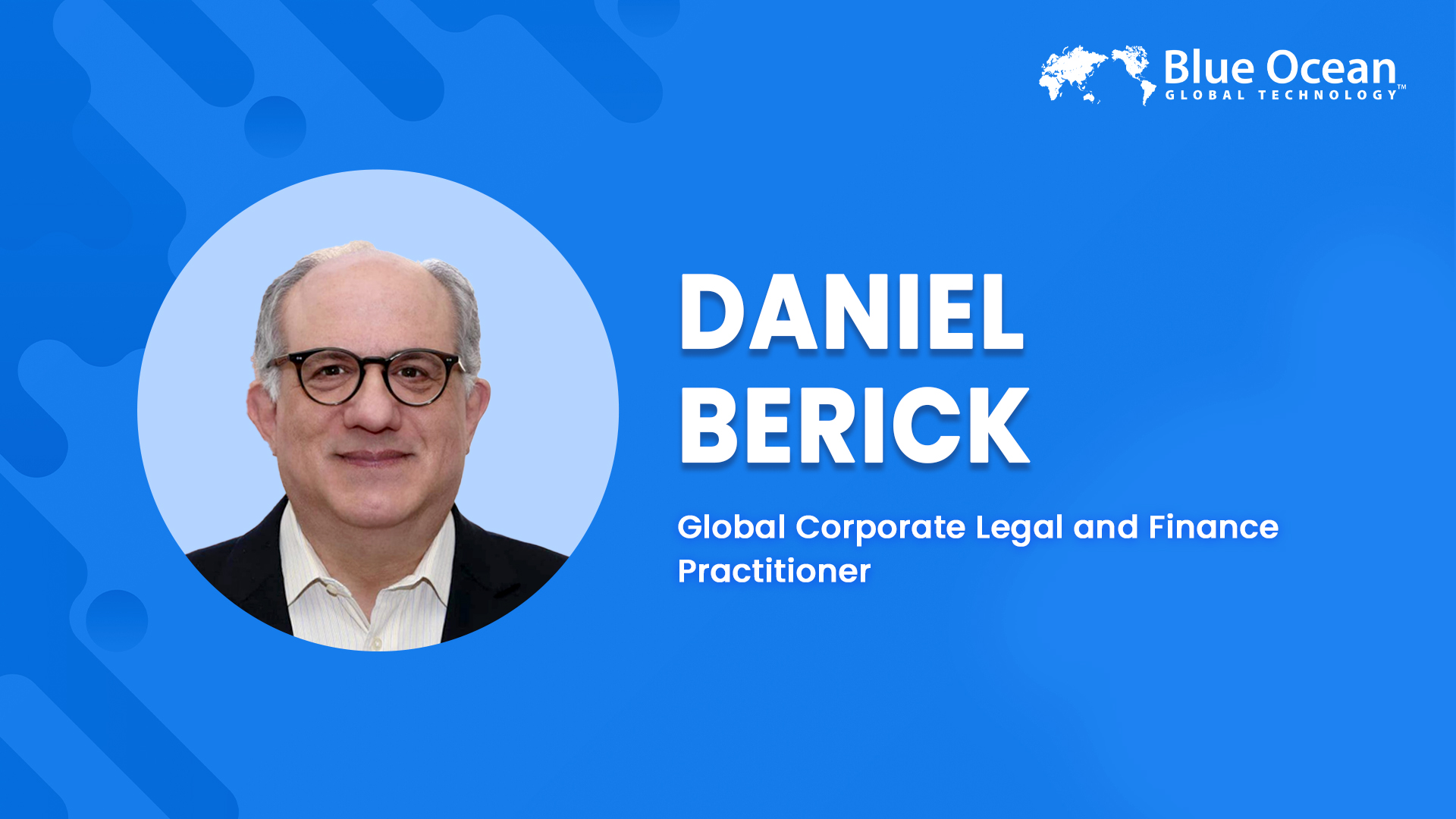
About Daniel Berick:

Dan Berick is a Partner in the Global Corporate Practice at Squire Patton Boggs, resident in the firm’s Cleveland, Ohio office. He has more than 35 years of experience in complex domestic and multi-jurisdictional transactions, including acquisitions, divestitures, carve-outs, joint ventures, corporate reorganizations, and venture capital and other private capital transactions. In addition, as co-head of the Squire Patton Boggs Family Office practice team, he advises family offices on a wide range of alternative investment transactions, including venture and private equity investments, private fund investments, and PIPEs and other structured investments, and on internal governance and entity structuring matters. Dan is a graduate of Columbia University, where his undergraduate major was Latin Language & Literature, and earned his law degree from the University of Chicago. He is also a husband and a father, and a published poet and short story writer.
Blue Ocean: With more than three decades in corporate law and leadership roles within a global practice, what initially inspired you to pursue law? What continues to drive your passion today?
Daniel: I’m a third-generation corporate lawyer. My grandfather was an immigrant to America and ended up practicing law in Cleveland, Ohio, where I still live. My father and uncle followed in his footsteps, and so did I.
For more than a century, a member of my family has practiced law in Cleveland. Growing up, I watched my father and uncle serve as trusted advisors to their clients. They were deeply invested not only in their clients’ businesses but also in their success and well-being. I admired that tremendously, and it remains a principle that guides me today.
The legal profession has changed dramatically since my grandfather began practicing in 1918. Yet, despite all those changes, it remains fundamentally a people business. Clients hire me and our firm to advise them on matters that are deeply important to them. Whether those matters involve business issues or personal concerns, the relationships with our clients remain essential.
And that’s what still inspires me to do it: the connections that I’ve made with the clients and colleagues over all these years.

Blue Ocean: What does a typical day look like for you? How do you manage your leadership responsibilities?
Daniel: It would be a cliché to say that there’s no typical day, but that is both the challenge of this job and also what’s really interesting about it.
I spend most of my time doing client work rather than administrative or internal tasks, which is great, and I enjoy it the most. So my typical day is really stretched by our global footprint and our global platform. We now have almost 50 offices across 30 countries around the world, and we operate as a highly integrated, close-knit global partnership.
My day usually begins quite early. One of the first things I do when I wake up is check my email to see what my colleagues—many of whom are already well into their morning in Europe or the Middle East—may need. Quite often, before I’m even fully dressed for work and before I’ve had the first of what is undoubtedly too many cups of tea, I’m already responding to messages or helping move matters forward. I’m always conscious of what time it is in other parts of the world and whether something is pressing that needs to be addressed “first thing”.
Much of the rest of my day is spent on client matters, and the nature of that work depends heavily on which projects are active at the time. My practice is primarily focused on corporate transactional work, so the pace of a transaction often dictates the rhythm of the day. If we’re approaching the signing or closing of a deal, there can be periods of particularly intense activity. At the same time, there is always a steady stream of non-transactional client work requiring attention.
I also take my role as a mentor, teacher, and resource for younger colleagues very seriously. Most days include conversations with junior partners seeking guidance on how to approach a particular issue or situation, as well as discussions with more junior lawyers who are looking for practical advice, feedback, or support as they develop their skills. Those interactions are among the most rewarding parts of my work.
By the evening, the cycle begins again as the workday starts in Asia and Australia. It is not unusual, particularly when we are working on a cross-border matter, for me to be watching for emails at night from colleagues in those regions and responding to questions or requests as their day gets underway.
Blue Ocean: What key lessons have shaped your approach to navigating complex multi-jurisdictional transactions?
Daniel: Cross-border work is a big part of my practice and has been for a long time, and given the way our firm is set up, it’s a big part of the practice for a lot of us, all over the world. It’s really interesting to see how business is conducted in different parts of the world, not just the legal aspects of it, but the business cultures and how people communicate with each other in business settings.
The key lessons and what I try to work with my junior lawyers who are newer to these kinds of transactions is to make sure you’re actually listening and observing because the legal culture, the legal process itself, and the business culture are very different in different parts of the world.
Transactions that involve my colleagues in several different countries take a lot of both process management and a lot of listening and forethought to remember. For example, in some countries, a document can be in English to have legal effect, while in others it has to be in the local language, and in some it depends on the nature of the document and whether the translation has been authenticated by a local authority. As lawyers, we need to anticipate those differences and build them into the process from the outset.
At a broader level, it means recognizing that there is no single “right” way to conduct business. Different countries have different expectations regarding timelines, approvals, documentation, and negotiations. Part of our role is helping clients understand those differences. When working with American clients, for example, we often explain that completing a transaction in another jurisdiction, France, for instance, may involve additional procedural steps, longer timelines, or regulatory requirements that would not exist in the United States. Engaging with our local colleagues early and planning accordingly is often critical to a successful outcome.
The same dynamic exists in reverse. We regularly support colleagues and clients from our non-U.S. offices who are investing or doing business in the United States. In those situations, we often find ourselves explaining aspects of American corporate law that differ substantially from English law and even more so from the civil law systems that govern much of the world. There is a significant educational component to cross-border practice, both for clients and for legal teams.
Blue Ocean: What emerging trends in law do you believe will most significantly shape the future of client relationships and legal practice?
Daniel: The thing everybody wants to talk about around legal practice is AI, and it’s hard to know exactly what it’s going to mean, but it’s going to be significant, as the introduction of the internet was.
When I started practicing law, I didn’t have a computer because we didn’t even use them at that time. In many ways, we were practicing law in the same way as in my grandfather’s time.
Before you had a computer, you had a secretary, and he or she, usually she, could take shorthand, and you would give dictation, and correspondence would be sent by mail. I remember when FedEx was a new thing and fax machines- like, “wow, this will change everything”.
The acceleration of the pace of things continues, and AI will have a lot to do with that. I don’t even want to try to predict how people will use it, but it will continue to accelerate the speed at which things are able to be done. It will have its own risks associated with it, but over time, those will get worked out.
When it comes to client relationships, I think there are two important considerations. First, clients will increasingly expect lawyers and law firms to embrace and effectively utilize new technologies as they become available. If you imagine a law firm in 2002 telling a client, “We don’t use the internet or email—just call us on the telephone because that has always worked fine,” that would have seemed wildly out of touch. Yet some firms and businesses were slow to adopt those technologies because they were accustomed to doing things a certain way. I believe the same dynamic is playing out today with artificial intelligence and other emerging technologies.
At the same time, the fundamental nature of the attorney-client relationship has not changed. Clients hire people, not technology. Whatever tools lawyers choose to incorporate into their practice, clients must still trust the individuals providing the service. They need to feel that their matters are important, that their lawyer understands their objectives, and that their concerns are being treated with care and attention. Those core elements of trust, responsiveness, and personal commitment have remained constant since my grandfather’s time and, in my view, will continue to remain constant regardless of technological advances.
What has changed is the speed, scale, and efficiency with which legal services can be delivered. Many routine tasks and processes will likely be handled far more quickly through technology. Just as the telephone, the fax machine, email, and the internet were once viewed as revolutionary innovations that transformed the practice of law, artificial intelligence represents the next major evolution. While it is difficult to predict every implication, AI is likely to be the most significant macro-level change affecting the legal profession in the coming years, reshaping how lawyers work while leaving the essential human foundation of client service intact.
Blue Ocean: Can you share insights into a particularly complex corporate or transactional matter you’ve handled, and explain how you approach strategy, risk assessment, and execution under pressure?
Daniel: The most complicated matters are some of the cross-border projects, because there are many different work streams that all have to end up at the same point in space and time to complete them. And there are so many different people and competing kinds of legal necessities around them.
We had a transaction that involved a client selling a global manufacturing operation in 25 countries. And the challenge in trying to align the timing of those work streams was really kind of a massive undertaking. Some jurisdictions just take more time to do things. And the nature of the business was such that there were factories in a bunch of countries, and so we were transferring ownership of companies that own manufacturing facilities and have thousands of employees in countries all over the world.
When you get down to the level of local permits, operating licenses, and regulatory approvals, the complexity of cross-border transactions becomes very real. We often encountered legacy employment disputes that seemed never-ending. In one South American country where the client had operations, there were multiple municipal permits that no one had paid much attention to until a change of ownership occurred. Suddenly, the local municipality saw an opportunity to revisit every potential issue, and what appeared to be a minor administrative matter quickly multiplied into a number of separate workstreams.
Then you layer on challenges such as the process of transferring real property in India, which can be remarkably intricate. Requirements may include obtaining the physical signature of a designated corporate officer before a recording official in a particular jurisdiction, with strict procedural formalities that must be followed precisely. The sheer volume of legal and logistical details involved in coordinating a transaction like that around the world can be staggering.
All of this must be managed while serving a client with reporting obligations and firm transaction deadlines. The client needs to be able to tell shareholders and regulators that a divestiture has been completed on specific terms by a specific date. Achieving that objective requires coordinating local counsel, regulatory requirements, tax considerations, and transaction teams across numerous jurisdictions and time zones. It is incredibly complex and, at times, extraordinarily stressful.
The old cliché applies: How do you eat an elephant? One bite at a time. The success of these transactions depends heavily on upfront planning and disciplined project management. Before anything begins, you have to map out the workstreams, identify responsibilities, establish reporting structures, and determine how information will flow back to a central team for consolidation and communication. Without that framework, the process can quickly become unmanageable.
The oversight strategy often resembles a hierarchy of interconnected checklists. Individual workstreams roll up into broader categories, which in turn feed into a master transaction plan.
What makes the work fascinating is that it gives you a truly global perspective. One day you’re speaking with local counsel in Armenia, the next with colleagues in India, Brazil, or Argentina. It makes the world feel surprisingly small. You develop relationships with professionals across jurisdictions and gain a firsthand appreciation for how different legal systems and business cultures operate. It makes the world feel like a very small place.

Blue Ocean: Having built a strong practice, how do you and your team continue to stay ahead in such a fast-paced environment, particularly as trusted advisors for family offices?
Daniel: That’s always the challenge, because you could spend all day sort of doing research and never actually get any work done. So it’s kind of a combination of things.
We’re fortunate at our firm because we are both very large and highly integrated. Within our global platform, we have a dedicated family office practice group consisting of approximately 75 lawyers around the world. Every other month, we meet as a team to exchange ideas, discuss developments, share client experiences, and identify emerging trends. Those conversations are invaluable because they allow us to benefit from the collective knowledge and perspectives of colleagues working across different jurisdictions and markets.
Of course, we also stay informed through more traditional channels. We follow industry publications, monitor legal developments, and keep up with relevant trade press. But one of the most effective ways to understand what is happening in the family office space is simply to stay connected with clients, even when there is no specific transaction or project underway, and hear from our colleagues what they are seeing from their clients.
Family office clients are distinct from large corporate clients. The relationships are highly personal because the individuals involved are often family members themselves or professionals who work closely with them. Maintaining those relationships and checking in regularly provides valuable insight into the challenges, opportunities, and priorities that are shaping their decision-making.
Blue Ocean: What core values or guiding principles do you believe every great lawyer should uphold regardless of specialization?
Daniel: At the end of the day, that is really the fundamental question. Everything else is secondary.
Perhaps I’m a bit old-fashioned, but to me the core values of a great lawyer are honesty, transparency, and integrity. On my desk, I keep a photograph of my grandfather and me when I was a small child. He was a lawyer, and I often think about whether the decisions I make and the way I conduct myself would make him proud. I would never want to do anything that he would have considered dishonorable.
Beyond the substance of the work itself, I believe these values are especially important in the learned professions. One of the traps lawyers can fall into is allowing economic pressures, time constraints, or business considerations to push them into taking on matters they are not truly qualified to handle. I understand the realities of making a living, but one of the defining characteristics of a great lawyer is the ability to be honest about what they know and what they do not know.
To me, a lawyer’s word should be their bond. People sometimes try to draw distinctions by saying, “Well, I never put that in writing,” or “That wasn’t technically part of the agreement.” I have very little patience for that way of thinking. If you commit, people should be able to rely on it, whether it appears in a written contract or not. Your reputation is built on the confidence others place in your word.
Equally important is understanding the limits of your own expertise. The longer you practice law, the more people assume you know everything about every area of the law. Friends, acquaintances, and clients routinely ask questions about legal issues that fall entirely outside your field. My response is often simple: “Let me find the right person for you—that’s not what I do.” There is no shame in acknowledging that; it is a mark of professionalism.
Being honest with yourself about your capabilities and being honest with others about what you can and cannot do is essential to building trust. When someone says, “Dan told me he would do this, and I know I can count on him,” that means more to me than any title or accolade. That’s my reputation. That’s my good name.
Blue Ocean: What are some common misconceptions people have about corporate attorneys or transaction work? And what do you wish more people understood about this field?
Daniel: One of the most common misconceptions about corporate law is that it’s boring. People often assume that if you’re not standing in a courtroom arguing before a judge or jury, the work must be dull or lacking excitement.
Corporate and transactional practice is no less interesting; it’s just different. My career is fundamentally different from that of a trial lawyer, and that’s part of what makes the legal profession so diverse. The challenges, skills, and rewards are different, but they are no less engaging.
Beyond that, the bigger misconception is that corporate law is impersonal. Because you’re often representing corporations, banks, investment funds, or other business entities, people assume there is little human element involved. In my experience, that could not be farther from the truth.
At the end of the day, every transaction involves people. You’re working with executives, entrepreneurs, investors, founders, board members, and employees. These transactions often affect their businesses, careers, livelihoods, and long-term goals. The fact that the client is a corporation does not eliminate the human dimension.
One of the things I enjoy most about transactional practice is the opportunity to work with a wide variety of people and personalities. Every deal introduces you to new industries, different business models, and individuals with unique perspectives and objectives. Whether you’re representing a bank, a multinational corporation, a venture capital firm, a family office, or a startup founder, the human element is always present. Relationships, trust, communication, and problem-solving remain at the center of the work.
Another misconception that is particularly close to my heart is the belief that you need a business, finance, or accounting background to become a successful corporate lawyer. Many students assume that if they are not finance majors, business majors, or economics majors, corporate law is not for them.
That is a significant misunderstanding. Some of the best corporate lawyers I know studied history, literature, music, philosophy, or other liberal arts disciplines. I often joke that my mathematical abilities are fairly limited. Beyond basic arithmetic, I would not claim any special talent for finance or accounting.
The skills that make someone an excellent corporate lawyer are not necessarily the same skills required to earn an undergraduate business degree. What matters far more is intellectual curiosity, strong analytical thinking, attention to detail, effective communication, sound judgment, and a willingness to learn. The technical aspects of finance and business can be taught. What is harder to teach are the critical thinking and problem-solving abilities that great lawyers have.
As a result, I often encourage students not to disqualify themselves from corporate law simply because they lack a formal business background. In my experience, that background is neither a prerequisite nor a predictor of success. When I look at the most accomplished corporate lawyers I know, their success is not the result of an undergraduate finance degree they earned years ago. It comes from their ability to understand complex issues, build relationships, solve problems, and serve clients effectively. Those qualities transcend any particular academic major.

Blue Ocean: Over a long and accomplished career, how have you maintained resilience and perspective while management, how high pressure and high pressure deals and complex client matters?
Daniel: The practice of corporate law can sometimes appear intimidating from the outside. To someone considering the profession, or even to a lawyer just starting, it can seem very monolithic, as though there is only one model for success and that you have to fit into a particular mold or conform to a specific personality type to thrive.
One of the most important lessons I’ve learned is that resilience and perspective come from maintaining a strong sense of who you are as a person. You do not have to abandon, hide, or suppress your authentic self to become a successful lawyer. The opposite is true.
The lawyers who sustain long, successful, and fulfilling careers are often those who remain grounded in the things that matter to them outside of work. They continue to pursue the interests they enjoy, invest in meaningful relationships, and stay connected to the activities, causes, and communities that give them purpose. Whether that’s horseback riding, painting, advocating for housing rights, volunteering, playing music, or any number of other pursuits, those interests are not distractions from professional success.
Sometimes people fall into the trap of believing that if they want to become a successful transactional lawyer at a major law firm, they must devote themselves entirely to their career and set aside everything else that defines them. They stop doing the things they love because they don’t appear to advance their professional goals directly. But when you give up those parts of yourself, you lose more than hobbies or interests. You lose the very foundation that provides perspective, balance, and resilience.
When challenges inevitably arise, you need something to draw upon beyond your professional identity. If your entire sense of self is tied to your job title or career progression, setbacks can feel overwhelming. By contrast, when you maintain a rich and authentic life outside of work, you have a broader perspective and a stronger foundation from which to navigate difficulties.
This is something I often discuss with younger lawyers, especially when they ask questions about career development, client relationships, or professional success. People frequently want a formula or a checklist: How do you develop clients? How do you build a successful practice? How do you advance in your career?
The truth is that there is no single recipe. But if there is a starting point, it is being genuine and remaining true to yourself. Authenticity matters. People can sense when someone is trying to be something they are not in pursuit of a professional or financial objective. The strongest relationships are built on trust, and trust is rooted in authenticity.
When you begin constructing a professional persona that bears little resemblance to who you really are, you eventually lose touch with the source of your own strength. You no longer have a reliable foundation for perspective or resilience because you have set aside the very qualities that make you unique.
For me, resilience is not about becoming someone else. It is about remaining yourself. The more successful lawyers I have known over the years are not those who fit neatly into a predetermined box; they are those who understand who they are, stay true to their values, and bring their authentic selves to their work every day. That authenticity is what sustains them through challenges and, ultimately, what makes them effective counselors, colleagues, and leaders.
Blue Ocean: So we understand that you have a strong appreciation for books and history. How have these interests impacted your life and your career?
Daniel: Books are a great source of perspective and, therefore, resilience. The two are combined to have a sense of history and to have a sense of how people have behaved and responded to situations throughout history. It’s always just an interest of mine, literature and history.
When I was in college, I was a Classics major and spent my time studying Latin. I remember saying something to one of my professors about the tension between pursuing a demanding professional career and maintaining intellectual interests outside of work. He said, “Just because you go to law school instead of pursuing a Ph.D. doesn’t mean you can never read Virgil again.” That response has always stayed with me.
And that’s really what we’ve been talking about. It’s entirely possible to work hard, devote yourself to your profession, and spend long hours doing meaningful work, while also preserving the other parts of yourself that make life rich and fulfilling. I can spend a day immersed in complex legal matters and then go home and read poetry, pick up a biography, or explore an entirely different subject that helps me better understand the world and the people around me.
Those pursuits are not distractions from professional success; they complement it. They broaden your perspective, deepen your understanding of human nature, and remind you that there is a larger world beyond your immediate work responsibilities.
Most importantly, you do not have to abandon those interests—or any other part of your identity—to succeed professionally. You can be fully committed to your career while remaining curious, engaged, and connected to the things that matter to you personally. Those outside interests often make us better professionals because they help us maintain balance, perspective, and a richer understanding of the people we serve.
Blue Ocean: Is there a guiding principle, historical lesson, or a quote that has significantly influenced your career in the way you approach both law and leadership?
Daniel: My guiding principles are honesty and transparency.
There is a motto attributed to a British general from the First World War: “Trust, training, and thoroughness.” I’ve always found that philosophy compelling because it captures many of the values that matter most in professional life.
Honesty begins with acknowledging reality. If a client points out a mistake and says, “We noticed this issue, and it doesn’t seem right,” my response should be, “You’re right. Here’s what happened, and here’s how we’re going to fix it.” Mistakes happen. What matters is how you respond to them.
The same principle applies internally. I tell younger lawyers all the time not to assume that seniority equals infallibility. If something I’ve drafted doesn’t make sense, or if they believe I’ve overlooked an issue, I want them to speak up. In fact, I often tell them that they may very well be right. Experience is valuable, but it does not make anyone immune to error.
One of the challenges of a hierarchical profession is that younger professionals can sometimes feel pressure to project certainty even when they are unsure. They may believe they need to appear as though they have all the answers in order to gain credibility. But that’s not how real growth happens. The healthiest professional environments are those where people can ask questions, admit uncertainty, and learn openly.
Transparency means being honest with yourself about what you know, what you don’t know, and where you need help. It also means being candid with clients and colleagues. That approach may occasionally feel uncomfortable in the short term, but I believe it is the only sustainable long-term strategy.
The alternative is to hide mistakes, convince yourself that you know more than you do, or try to project an image of perfection and infallibility. The problem is that no one can maintain that illusion indefinitely. Eventually, reality catches up, and when it does, the consequences can be significant. Trust is far easier to preserve through honesty than it is to rebuild after it has been damaged.
At its core, this philosophy is really about humility. No matter how experienced you become, there is always something new to learn, a different perspective to consider, or a better way to approach a problem. The most effective lawyers and professionals never stop learning.
So if I had to identify a single guiding principle, it would be this: be honest with yourself, be transparent with others, and remain humble enough to recognize that growth never truly ends. In the long run, that approach builds trust, strengthens relationships, and creates the foundation for both professional success and personal credibility.
Blue Ocean: What are your hobbies? What are your interests? What do you like to do in your free time?
Daniel: I read a lot of literature, novels, biographies, history, poetry, just about anything that captures my interest.
From time to time, people ask me what management books have had the greatest influence on my leadership style. I’m always a little embarrassed by the question because my answer probably sounds more dismissive than I intend it to.
The truth is, I’ve never been much of a management-book reader. That’s not because I think there’s anything wrong with them; I’ve simply found that most of what I’ve learned about leadership, human behavior, and how people interact in professional environments has come from reading literature rather than books specifically about management. The insights I’ve gained about relationships, motivations, conflict, trust, and collaboration have often come from novels and stories that explore the complexities of human nature.
Reading has always been a significant part of my life, but so has writing. In my spare time, I write poetry and short fiction, and that’s probably my most important hobby at the moment. I enjoy the creative process, the discipline of writing, and the opportunity it provides to think about the world from different perspectives. In many ways, it complements my professional life by exercising a very different set of skills.
Beyond that, my family is incredibly important to me. My wife and I have children who are roughly the same age as many of the young professionals I work with, and spending time with them remains one of my greatest priorities and joys.
Check out some of Dan Berick’s poetry here: https://montereypoetryreview.weebly.com/fall-2025-poems/dan-berick
Conclusion
Dan’s career is a testament to the enduring power of relationships, integrity, and authentic self-knowledge in the practice of law. Across more than three decades of complex cross-border transactions, family office advisory work, and mentorship of the next generation of lawyers, one principle has remained constant: the human element is irreducible. Shaped by a family legacy stretching back more than a century, guided by the values of honesty, transparency, and humility, and sustained by a deep engagement with literature, history, and writing, he brings to his practice not only formidable technical skill but a rare breadth of perspective. For Berick, the measure of a great lawyer is not the complexity of the deals closed or the titles earned, but the trust placed in one’s word and the lives genuinely served along the way.
Do you have a personal or professional story that can inspire other people into becoming the best version of themselves?
You are welcome to share your journey with our audience.