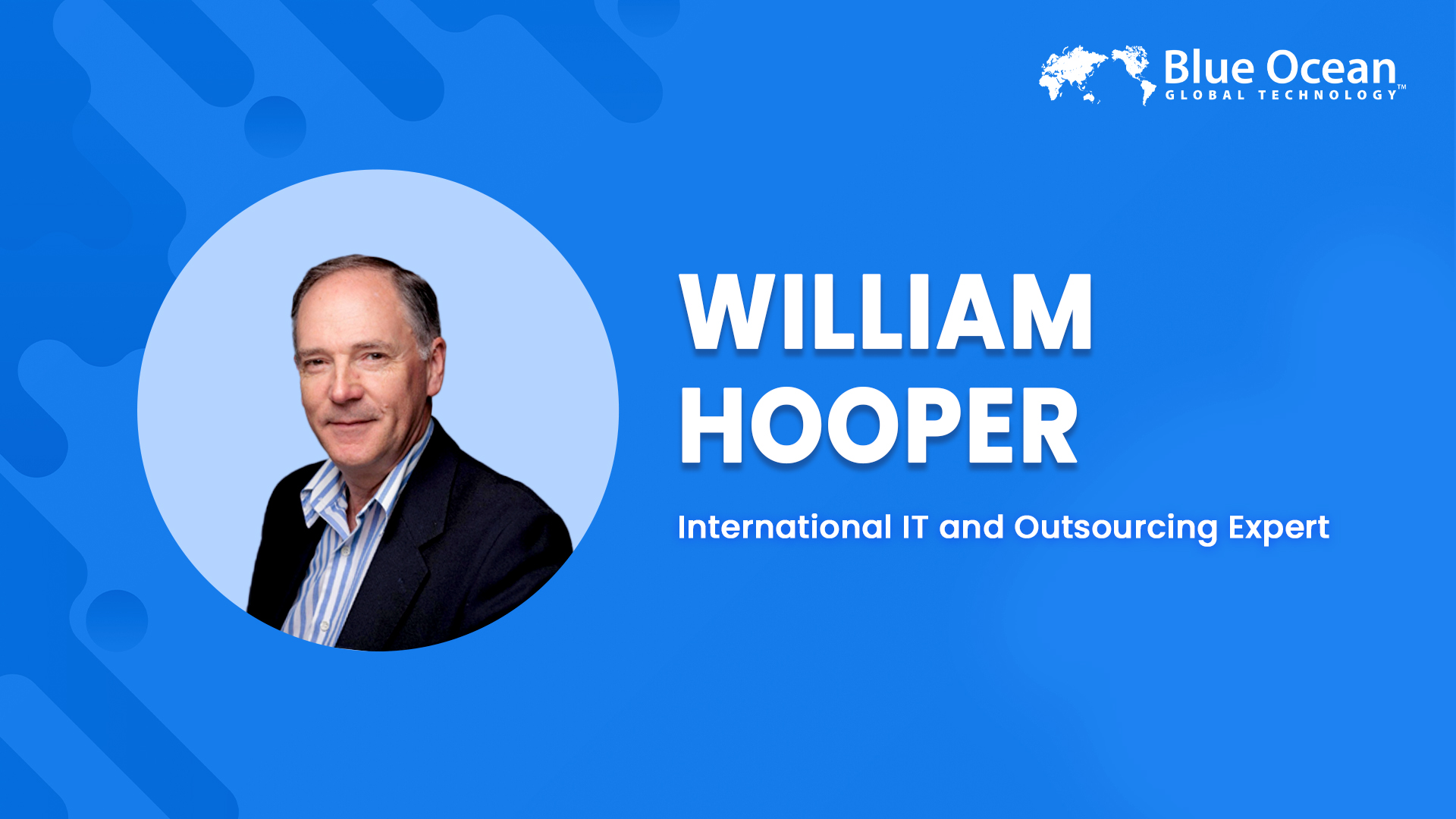
About William Hooper:

William Hooper is an international IT and Outsourcing expert. As a delivery consultant, he has more than 20 years of experience, including leading roles and systems serving millions of users. Projects have included the operational recovery of distressed services. As an expert, he has reported in multiple jurisdictions on small and large cases. He is chair of the Academy of Experts, in which capacity, he is active in leading the development of expert practice and standards. He holds a bachelor’s degree in engineering and an MBA. He holds professional accreditations in engineering, IT, accounting, and expert work. He has a particular interest in the business application of technology and the transformative effects it can deliver.
Blue Ocean: Can you walk us through your professional journey? What initially drew you to IT, and what continues to motivate your work today?
William: I started my career as an engineer, first working on gas turbines and later on photocopiers. I spent many years with Xerox before moving from engineering into finance and accounting, eventually completing my MBA at London Business School. After that, I returned to Xerox.
That transition led me into the world of emerging technologies. I became involved in the sales and delivery of document management systems offered by Xerox, which exposed me to the transformative impact technology could have on organizations and the value it could create through change. From Xerox, I moved to Fujitsu, a large Japanese-based managed services provider, where I worked on delivering systems at significant scale—supporting hundreds of thousands of users.
From there, I joined an international management consultancy. It was an intellectually rigorous environment, and I found myself dealing with some particularly challenging situations, including troubled services that had failed and needed recovery. These were non-legal disputes before I became involved in legal ones.
Eventually, I established my own consultancy, initially advising organizations on the procurement and transition of outsourced services. Around the same time, I also began providing expert witness services on a very small scale. We all have to start somewhere, and we all make mistakes. It helps if your first mistake is not a monumental and public disaster.
Looking back, I would write those early reports quite differently today. But learning is part of the process, and I always hope to keep improving. That experience gradually led me into expert witness work related to IT disputes—starting with smaller, private matters and eventually progressing to much larger and more complex engagements.
I would love to say this was all carefully planned and that becoming an expert witness had always been my ambition, but that would not be true. It is a profession built on years of accumulated experience. Most of us arrive later in our careers because the work depends on lessons learned over time, often through our own mistakes. Having made those mistakes yourself gives perspective. When you see someone else make an error, you think, Yes, I have made that one too. And perhaps that softens your approach to both the work and the people involved.

Blue Ocean: What does a typical day look like for you as an expert in IT and outsourcing disputes, while also advising clients on complex service delivery and transformation initiatives?
William: I typically have several clients underway at any one time. I am, perhaps, a fairly simple creature. I am not particularly good at doing many things simultaneously, so I try to structure my time in a way that allows me to focus deeply on one task at a time and give it proper attention.
When I am working on a dispute, everything revolves around clarity of thought. This morning I spent several hours reviewing a draft with one of my assistants. I asked him to take on the role of the opposing expert—to challenge me, attack the arguments, and expose weaknesses in my reasoning.
It became quite a lively debate because I would much rather uncover weaknesses privately before I sign a report. In many ways, it was enjoyable because we were working collaboratively toward the same goal: finding the strongest and most defensible answer. That process of challenge and refinement is enormously valuable.
A great deal of expert work, if I am honest, can be rather repetitive. You often begin with thousands—or in larger cases, millions—of documents and must first determine what is worth examining before beginning the real analysis.
The process is iterative. You ask yourself a question, research the answer, and in the course of that research, refine the question itself. Then you return to the evidence and repeat the process. It is an ongoing search for truth buried within vast quantities of information.
What I believe I bring is the perspective of a consultant approaching the operational side of a problem. I am trying to answer questions such as: Why did this dispute arise? What actually went wrong? The lawyers approach the same issue from a different angle—the legal framework and points of law. If we do our jobs properly, we arrive at the same destination from different directions, complementing one another. The lawyers build the legal case; I help explain the operational reality behind it.
I work primarily in the UK, where civil disputes are generally heard before a judge rather than a jury, or in international arbitrations involving one or three arbitrators who serve a similar function. The decision-maker is ultimately trying to determine the case according to the law. And judges—particularly in the UK, where most are lawyers—do not necessarily enjoy technical complexity, even though they must deal with it.
That creates an important challenge for experts. Many experts say far too much. We are often asked to say as little as possible while making the issues clear. The real skill lies in being concise, precise, and understandable. Saying less, but saying it more clearly, often has a greater impact.
On a day-to-day basis, if I am working on a dispute, much of my time involves reviewing evidence, trying to make sense of it, asking questions, researching answers, writing notes, and then refining those notes repeatedly. It is often solitary work—long hours spent with documents and analysis.
When I am involved in delivery work, I try to separate it from expert work so I can focus entirely on one role at a time. Delivery work tends to be more sociable and often takes place on client sites. The nature of the work varies considerably depending on the assignment.
For example, I was recently supporting a bank working with its commercial managers to help them understand how to manage their contracts more effectively. That type of work is interactive.
I also have a few activities I keep for what I suppose could be called light relief. I serve as Chair of the Academy of Experts, which is a voluntary role. It is a professional association for experts, and we organize talks and events, inviting judges, lawyers, and fellow experts to share knowledge and perspectives.
Those smaller commitments enrich life and, in some ways, feel like giving something back. Little things that contribute beyond the day-to-day work.
So, is there really such a thing as a typical day? Certain patterns remain constant—researching evidence, asking questions, solving problems—but no two days are exactly alike. And perhaps that variety is part of what makes the work so interesting.
Blue Ocean: Which emerging trends in IT services, outsourcing, digital transformation, or expert witness work do you find most exciting today?
William: People in technology tend to have short attention spans because the field changes constantly. At the moment, everything seems to revolve around artificial intelligence—you can hardly open an article without AI appearing somewhere. But if I may cheat slightly, for me it is not really about the technology itself; it is about what you can do with it.
Technology accelerates change and expands what is possible within a business. It creates entirely new opportunities, and that is what makes it exciting. We see this through digital transformation and the emergence of new business models that evolve at a bewildering pace. But alongside those opportunities come significant risks.
We see those risks in areas such as disinformation, cyber threats, and the erosion of personal privacy. We all need to be careful about what we place online because trust itself is changing. Technology is also creating broader strategic challenges. Few people predicted the extraordinary value companies such as NVIDIA would create. They were once viewed as relatively unremarkable chip manufacturers; today, they are among the most valuable companies in the world.
Students entering university now often wonder whether learning to code remains worthwhile. I believe it absolutely does. Coding still has tremendous value in understanding how a programme works. For me, however, the real focus remains on what technology enables people and businesses to achieve.
Artificial intelligence is fascinating because it opens up an enormous range of possibilities. It genuinely feels revolutionary. At the same time, there are more concerning developments—particularly in areas such as cybersecurity and personal data protection. Bad actors are becoming increasingly sophisticated and are now using advanced tools themselves, making it more important than ever to safeguard systems and information.
I also find areas such as crypto and blockchain interesting, although they are not my specialties. After a great deal of hype, these technologies now seem to be settling into more practical and sustainable uses as they gradually enter the mainstream.
Another area that particularly interests me is the way technology itself is delivered. Approaches such as DevOps, which integrate software development and operations, are fundamentally changing how systems are built and maintained. They enable organizations to support rapid change while preserving stability, which is increasingly important in modern software delivery.
I appreciate that this may sound rather technical—perhaps even a little too “geeky” for those outside software engineering—but for those of us in the field, these developments are genuinely exciting. Ultimately, it always comes back to the same point: technology itself is only part of the story. What matters is what people can do with it.

Blue Ocean: You have served as a testifying expert in multiple jurisdictions on complex IT and outsourcing disputes. Can you share insights into a particularly challenging case and explain your approach to resolving highly technical and high-stakes matters?
William: In most disputed matters, reality is rarely as simple as one side being entirely innocent and the other irretrievably at fault. Usually, there are weaknesses and difficulties on both sides. If matters were completely clear-cut, people would resolve them long before they reached a legal dispute.
That can be difficult for clients because someone who genuinely feels wronged must also confront their own weaknesses. I can think of one client whose case was very finely balanced. They asked me, “Should we pursue this dispute?” I explained both the strengths of their position and the areas that would create difficulties. My conclusion was that they would probably recover something, but the process itself would be painful and damaging.
In the end, they decided not to proceed. That experience reinforced an important lesson: disputes should never be entered into lightly. If you decide to fight, you have to commit yourself fully. There is a personal dimension to litigation that clients must resolve for themselves. You can advise someone about the strengths and weaknesses of a case, but if their heart is not truly in it, pursuing the matter may not be the right decision.
Not long ago, I worked with an insurance company that had experienced a failed digital transformation project. They had engaged a management consultancy because they lacked the internal capability needed to deliver the changes they wanted. The consultancy had been brought in to help guide that transformation—but things went badly wrong.
Initially, the consultancy deployed a very impressive team. They presented a compelling strategy and a clear vision for the future. We often refer to this as the “A-team”—the strongest and most experienced people. But once the initial phase was complete, that team moved on to other projects and was replaced by new personnel.
Unfortunately, the replacement team simply did not have the capability or experience necessary to deliver what had been promised. They lacked the skills required to manage the technologies and transformation work they had been tasked with implementing.
My first task was to examine the facts. I was presented with a spreadsheet containing a long list of complaints. Many of them overlapped or represented different symptoms of the same underlying issue. The challenge was not simply to review them but to simplify and clarify what had actually happened.
The question became: could I distill this mass of information into something coherent? Could I help the lawyers explain, in clear terms, what had gone wrong and why they believed the consultancy had failed?
That process eventually formed the basis of the pleadings—the legal articulation of the case. My role was to establish the standard that should reasonably have been expected: What did good performance look like? What was delivered instead? Where was the shortfall? And what consequences flowed from that difference? Ultimately, the damages reflected the cost of failing to meet that expected standard.
The lawyers then transformed that analysis into the legal case. I later prepared my reports, addressed those issues formally, and ultimately appeared before the tribunal to give evidence.
Much of expert work involves making sense of complexity—simplifying, clarifying, and distilling truth from large volumes of information until a coherent picture emerges. In this particular case, the arbitrator concluded that the customer had been misled regarding the capability of the delivery team. On that basis, she ruled in favor of my client, who was understandably pleased with the outcome.
Blue Ocean: With your multidisciplinary background spanning engineering, finance, project management, service management, and expert witness work, how do you continue to stay ahead in such a rapidly evolving and competitive industry?
William: It is a constant challenge. As an expert, part of what I am paid for is the ability to understand and interpret evidence, but maintaining the currency of my knowledge is equally important. In technology, where change happens at such a rapid pace, it means setting aside a significant proportion of time simply to stay up to date. I attend many meetings and professional association events, and I spend a great deal of time reading.
At the moment, for example, I am researching an important issue by working through a number of academic papers. Artificial intelligence can be useful in that process. It can help point me toward relevant research quickly—assuming, of course, that the citations are not hallucinated, which does occasionally happen. But ultimately, there is no substitute for doing the work yourself.
The challenge is balancing continuous learning with practical delivery work. If you spend all your time updating your knowledge but never apply it, you lose touch with real-world practice. On the other hand, if you focus only on delivery and stop learning, your expertise quickly becomes outdated. Technology evolves too fast for that. So maintaining relevance takes effort, although fortunately, it is also something I genuinely enjoy.
I love reading around my subject and exploring ideas beyond the immediate issue in front of me. Reading widely allows me to recognize patterns and build more persuasive narratives. Ultimately, if I am speaking to a judge or arbitrator, I have to remember that they are not technology specialists. My role is to explain matters in terms that make sense to them.
Curiosity, therefore, is an essential quality for an expert. You have to keep developing and continue learning. But there is another equally important principle: I have to stay in my lane.
By that, I mean I can have broad interests outside my core field. For example, one subject I find fascinating is psychology and how people make decisions. I am interested in it because understanding how people think helps me understand perspectives and communicate more effectively. It allows me to see the world through someone else’s eyes, which can make me a better expert.
But I do not present myself as a psychologist because I am not one. I may draw insights from that field, but my expertise remains in computer systems and outsourcing. Curiosity should broaden your thinking, but as an expert, you must always remain grounded within the boundaries of your expertise.
Blue Ocean: As a Chartered Engineer, Chartered IT Professional, and Chair of the Academy of Experts, what core principles or professional values do you believe every expert and advisor should uphold?
William: First, I would use three words because they are so closely connected that I cannot really separate them: integrity, independence, and objectivity.
These concepts are deeply intertwined because, under English law at least, an expert has an overriding duty to the decision-maker—the judge or arbitrator—to clarify the issues before the court. What that means in practice is that if I am truly independent and I encounter evidence that is important to understanding what happened, I must address it honestly.
For example, if my client made a significant mistake, I have a duty to acknowledge that weakness and give it the weight it deserves. Independence means dealing with evidence fairly, even when it is inconvenient.
There is a rather blunt expression in the expert world: the “hired gun.” It describes someone who will say almost anything to advance a client’s position, regardless of whether it is accurate or justified. The objective is to win points quickly rather than uncover the truth. That approach may work briefly, but not for long. Judges are very skilled at identifying advocacy disguised as expertise, and an expert who loses credibility rarely has a long career.
That is why integrity, independence, and objectivity sit at the top of my list of professional qualities.
The next principle is close behind: stay in your lane.
You can read widely and think broadly. I am an engineer by background, but I also love the arts. I enjoy poetry, although I would strongly advise against asking me to write any, and I appreciate art despite having absolutely no ability to create it myself. Broad interests enrich your thinking, but expertise has boundaries.
As an expert, I must stay within the field I have been engaged to address. That means doing the work properly. It involves long hours reviewing documents—many, many emails that are certainly not there for entertainment—and carrying out the analysis thoroughly.
You can use assistants, of course, and I do. They help process large quantities of information and identify documents they believe may be important. But ultimately, I must review and understand the key evidence myself, and I must ensure that nothing significant has been missed.
I can delegate support work, but I cannot delegate accountability.
At the end of the process, it is my signature on the report. I am the person who will stand before the court and defend it. If something is wrong, the responsibility is mine regardless of who first handled the material.
Ultimately, my role comes back to a principle I have mentioned before and will continue to emphasize: my duty is to clarify the issues for the court. To make complex matters understandable and to connect the evidence to the legal questions in a way that is clear, logical, and well-reasoned.

Blue Ocean: What are some common misconceptions organizations or legal teams have about IT outsourcing disputes and expert witness work?
William: The first misconception I often see relates to the service itself. A customer purchases one service and then sometimes assumes the supplier should also have delivered half a dozen additional things along the way. There can be an assumption that because I believe the supplier ought to have done this, a court will agree that the supplier failed in those imagined obligations—even when they were never part of the contract.
That approach is usually doomed to disappointment. Customers can sometimes have very vivid expectations, but courts generally focus on what was actually agreed rather than what one side later wished had been included.
A second misconception, again often from the customer side, is the belief that because something was imperfect, it must have been catastrophic. A relatively limited failure suddenly becomes the worst thing imaginable, accompanied by claims for enormous damages over what may be a comparatively minor issue.
But life—and business—are imperfect. Courts are interested in consequence and significance. They want to understand what actually happened, how serious it was, and what impact it genuinely caused.
On a related point, I have seen several cases—some outside my immediate area of expertise—where individuals genuinely felt they had been wronged, and in many cases, they probably had. The other side may indeed have caused real problems. But feeling wronged and proving a case are not the same thing.
The legal system places an obligation on the person making the allegation to prove the loss they claim to have suffered. If they cannot support that claim with evidence, they are unlikely to succeed.
I have seen some very expensive failures where people entered disputes prepared for a fight, but without the evidence necessary to support their position. That is often where early expert involvement becomes important.
Part of my role, if I become involved at an early stage, is to advise a client honestly. I may say: I think there is potentially a case here, but the evidence is not yet strong enough. Can we do something about that? Here are the types of evidence that could help support your position. Can you find them?
Because ultimately, I can only work with the evidence I am given. The misconception is not simply that people expect too much; it is the belief that conviction alone wins cases. It does not. Without evidence, even a strong grievance may never become a successful claim.

Blue Ocean: How do you maintain resilience and objectivity while managing sensitive or complex cases?
William: Resilience is something every expert eventually develops because one thing you can be sure of is that counsel—in the UK, we call them barristers—will challenge you. In court, there is a sense in which paranoia becomes quite rational. If paranoia is the belief that people are out to get you, then in cross-examination, they genuinely are. That is their role. So you have to be prepared.
Part of resilience, for me, comes from being careful and measured in what I say. I am not someone who believes every statement has to be the greatest, the biggest, or the most extraordinary. There is no place for that in court. Courtroom communication requires balance and restraint. We speak calmly of things we can justify.
Over time, I have learned to remove superlatives from my writing. Comparisons are fine—one thing may be better than another—but words like the greatest or the worst rarely help. If I have described the last five things as extraordinary, I will look rather foolish when I am cross-examined. More importantly, I will damage my credibility.
Moderation itself becomes a form of resilience. State things only as strongly as the evidence supports and avoid exaggeration. My objective is to build credibility with the court, and credibility is built carefully, steadily, and over time.
That approach may occasionally make for less dramatic testimony—perhaps even rather tedious listening for the poor judge—but accuracy matters more than theatrics. We have to proceed carefully.
If resilience comes from moderation and discipline, objectivity comes from the way you deal with evidence. Evidence has to be approached impartially and carefully. The method must be appropriate for the circumstances, and it must be applied properly using accepted principles.
Some evidence will support your client; some evidence will not. You have to treat both with equal seriousness. That is where objectivity begins.
One way I maintain that objectivity is by stepping back and asking myself: What would the other side’s expert say? If I were acting for the opposing side, how would I challenge my own argument?
By forcing myself to see the issue from that perspective, I often discover weaknesses in my reasoning or places where I may be overstating a point. And if I can identify how an opposing expert might attack my position, I can address those criticisms honestly and explain why they may—or may not—be valid.
That process makes the analysis stronger and ultimately more credible. It is an important part of how we work as experts: not simply presenting an argument, but testing it rigorously before anyone else does.
Blue Ocean: What advice would you offer to aspiring professionals interested in careers involving IT consulting, outsourcing strategy, dispute resolution, or expert witness work?
William: We are all different, and this is quite an extraordinary profession. I discovered it relatively late in my career, but I love it because it suits me.
That said, it is not a profession suited to everyone. It requires a rather unusual combination of skills: analysis, careful writing, and oral presentation. When considering any career, I think each of us has to ask a few honest questions: What am I good at? What am I not good at? Where are my strengths genuinely valued? And where are my weaknesses less exposed?
One of my weaknesses, for example, is that I become bored very easily. I would be a terrible operations manager, and I suspect I would be hopeless in retail. Retail demands constant attention to daily metrics, optimization, and repetitive adjustments. You are always looking at today’s numbers and rearranging things to improve performance. I know myself well enough to know I would become restless very quickly.
For me, expert work is a place where my strengths are valued, and my weaknesses are less prominent. It suits my personality and skill set. There is a good alignment between what the role requires and how I naturally think and work.
The fact that it is not ideal for everyone else is perfectly fine. Not everyone wants to do this work, and I am rather happy about that. A little less competition never hurts.
This is also a truly international field. There are relatively few people who take on the largest and most complex cases, and the opportunities can be remarkably broad. At the moment, I am working not only in the UK but also in South Africa and other jurisdictions.
For me, finding this profession has been enormously rewarding. I am very pleased to have discovered it—even if I found it later than expected. Though perhaps I should not encourage too many others to join, I would rather keep some of the opportunities to myself.
Blue Ocean: Is there a guiding philosophy, principle, or quote that has significantly influenced your career, leadership style, and professional approach?
William: There is a poem by Rudyard Kipling that begins: “If you can keep your head when all about you are losing theirs and blaming it on you…” It continues with themes of maintaining composure under pressure, trusting your judgment while remaining open to doubt, acting with patience, resisting bitterness, and remaining grounded in the face of both criticism and praise.
The poem speaks to qualities of character that I think are highly relevant to expert work. An expert must remain calm under pressure, balanced in judgment, measured in response, and disciplined in the face of challenge. Those are not just professional skills; they are personal qualities. And in many respects, I think they define the sort of person an expert should strive to be.
Blue Ocean: Outside of your professional responsibilities, what other hobbies or interests do you enjoy pursuing?
William: I have two working Labradors—both black dogs. I train them, although I sometimes suspect they train me as much as I train them. They provide a wonderful excuse to step away from my desk and out into the world. The weather does not really matter; you simply dress appropriately and get on with it. There is something deeply satisfying about heading out into the countryside with a dog that is completely in tune with you. I find it enormously enjoyable.
In the summer, I enjoy sailing. It is not very far from the south coast of England to France—about eighty miles, depending on the route—and I make the journey whenever I get the opportunity. It is a wonderful escape from work, and I must admit that the food, wine, and cheese in northern France provide additional motivation.
I used to love skiing as well, although a few injuries and the realities of age have started to catch up with me.
I also enjoy writing. My words will never match the beautifully crafted phrases of a great poet, but one can still aspire to improve. There is pleasure in trying.
Conclusion
William’s journey reflects the uncommon blend of technical expertise, strategic thinking, and professional maturity required to navigate the complex world of IT disputes and expert witness work. From engineering and finance to large-scale technology transformation and courtroom testimony, his career demonstrates that expertise is built through decades of experience, continuous learning, and a willingness to adapt. Throughout the conversation, one theme remains consistent: the role of an expert is not to advocate for a side, but to clarify complexity, uncover truth, and communicate with integrity. Whether discussing digital transformation failures, emerging technologies such as artificial intelligence, or the principles of objectivity and independence, William underscores that successful expert work depends not only on knowledge but on judgment, curiosity, and credibility. His reflections offer valuable lessons for professionals navigating technology, leadership, and dispute resolution in an increasingly complex digital world.
Do you have a personal or professional story that can inspire other people into becoming the best version of themselves?
You are welcome to share your journey with our audience.