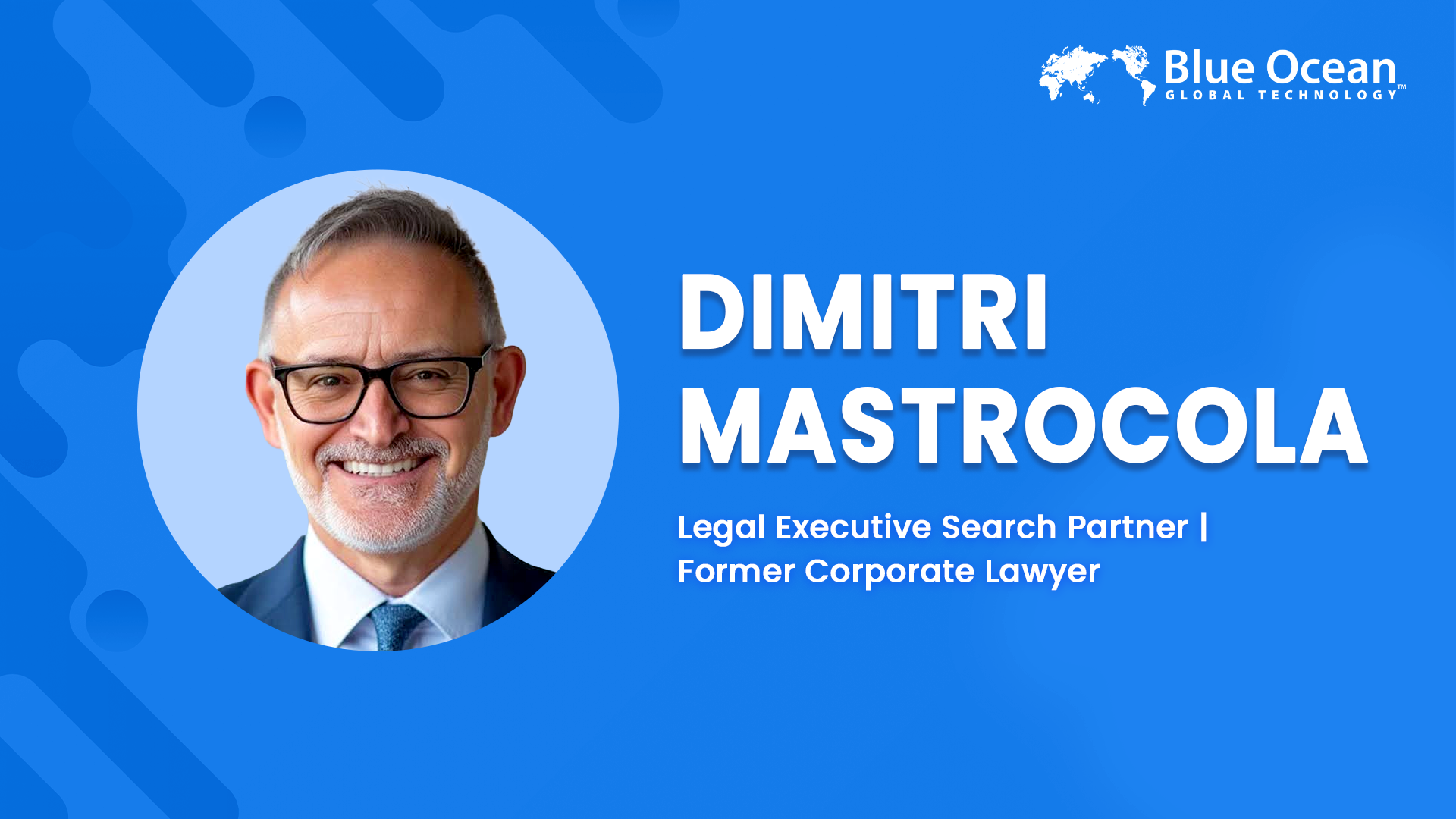
About Dimitri Mastrocola:

Dimitri Mastrocola is a Partner at Major, Lindsey & Africa, where he advises boards, CEOs, and senior leaders on high-stakes legal executive hiring. He joined the firm in 2005 and focuses on searches for General Counsel, senior in-house counsel, and compliance leaders across financial services, private funds, and alternative asset management.
A former corporate lawyer, Dimitri works closely with private equity firms, asset managers, banks, insurers, and sponsor-backed portfolio companies, navigating growth, complexity, and regulatory change. His work spans first-time General Counsel appointments through senior legal leadership roles at global institutions and high-growth businesses.
Through his advisory work and widely followed LinkedIn thought leadership, Dimitri shares practical, experience-based insights on legal leadership, hiring strategy, and how senior legal leaders contribute to value creation and risk management.
Blue Ocean: Can you walk us through your professional journey, from your foundation as a corporate lawyer to your leadership role in legal executive search? What initially drew you to this intersection of law, business, and talent?
Dimitri: I’m a lawyer by training. I grew up in Montreal, went to law school at McGill, and started my career as a corporate and M&A lawyer at Fasken, a large Canadian law firm.
About six years into practice, in the mid-1990s, I decided I wanted to become a New York lawyer. I had long been drawn to the idea of working at a major Wall Street firm, and I had already passed the New York Bar shortly after law school. A former classmate of mine, who had become a project finance banker at Banque Paribas, which later became part of BNP Paribas, helped circulate my resume to a number of major firms. That led to an opportunity at Shearman & Sterling, where I worked from 1997 to 2003 as a senior associate in the project finance group.
In 2003, I moved in-house and joined one of my clients, Citibank, where I practiced until 2005. By that point, I had become a very capable lawyer, but I had also come to realize that practicing law wasn’t where I wanted to spend the rest of my career.
In 2005, I left Citi and started a coaching practice for lawyers. It focused mainly on career and life coaching for law firm associates who were thinking about transitions. It was an interesting chapter, and I learned a lot from it, but it wasn’t financially sustainable at that stage of my life. I had a family to support, so I needed something more stable.
By mid-2005, legal search came into focus. It felt like a natural intersection of my legal background, my understanding of the market, and a real interest in careers, talent, and professional development. I reached out to a friend at Major, Lindsey & Africa for a reality check. One conversation led to another, and in November 2005, I joined the firm. I’ve been there ever since.
Blue Ocean: What does a typical day look like for you today at Major, Lindsey & Africa, and how do you balance strategic advisory work, client relationships, and leadership responsibilities across complex engagements?
Dimitri: Executive legal search is very different from practicing law, but there are meaningful parallels. Both require attention to detail, persistence, discipline, and a strong work ethic. When I transitioned into search, I was essentially starting over. I had to learn an entirely new profession— how to source candidates, assess talent, manage searches, and build relationships.
My legal training helped in important ways. Skills such as diligence, analytical thinking, clear writing, and effective communication translated well. But recruiting is fundamentally more people-oriented. Psychology plays a significant role. On the candidate side, you’re advising individuals who may be considering major career changes. On the client side, you’re working with CEOs, CFOs, COOs, heads of HR- hiring for roles such as general counsel or chief compliance officer. The interpersonal dimension is central to success.
There’s also a structural similarity between law and search: both are professional services businesses. Just as law firms must attract and serve clients for specific matters, search firms win mandates to identify and recruit top talent. Once engaged, the work differs significantly. In search, the core task is to identify, evaluate, and present candidates. It further involves sourcing talent, screening for fit, preparing written assessments, presenting a shortlist to the client, and managing the interview and feedback process. Client communication is ongoing, and candidate management is equally critical to keep strong prospects engaged throughout the process.
Early in a search career, you’re not leading client relationships. You’re supporting more senior consultants and focusing heavily on execution. It’s similar to being a first-year associate at a law firm: you handle discrete, time-intensive tasks. In search, that means researching databases and LinkedIn, identifying potential candidates, reaching out through calls, emails, or messages, conducting initial interviews, assessing fit, and drafting candidate reports. Sourcing and evaluating talent are the most time-consuming and foundational parts of the job.
Over time, the role expands to include greater responsibility for client development and overall search strategy. At its core, executive legal search is a balance of rigorous process management, candidate engagement, and client advisory, combining analytical discipline with strong relationship skills.

Blue Ocean: Which emerging trends in legal executive search consulting do you find most compelling, particularly those reshaping leadership needs and client expectations?
Dimitri: One of the biggest developments in our field is the practical use of AI to make parts of the work faster and more efficient.
Executive search involves a tremendous amount of writing. You’re reviewing resumes and cover letters, drafting candidate profiles, preparing assessments, summarizing interviews, and synthesizing a lot of information. With the right prompting and the right oversight, AI can be very helpful with those tasks.
It has also changed how we handle interviews. Our interviews are structured and often include open-ended and behavioral questions. Today, we can generate transcripts and use AI to help synthesize those conversations into organized summaries and draft assessments. What once took several hours per candidate can often be completed in 30 minutes or less. The time savings are substantial.
AI is also useful for drafting emails, organizing long threads, and creating cleaner internal or client-facing follow-ups after search calls. For example, after a weekly status call on a General Counsel search, AI can help turn a transcript or rough notes into a polished recap much more quickly.
That said, judgment is still everything. These tools are useful, but they require human review, discernment, and editing. What interests me most is how AI will continue to improve in areas like analysis support and workflow efficiency while leaving the most important parts of search, judgment, assessment, trust, and relationship-building, where they belong, in human hands.
Blue Ocean: You’ve built a reputation for working with private equity firms, alternative asset managers, and high-growth companies. How do you and your team stay ahead in such a competitive and rapidly evolving market?
Dimitri: When I joined Major, Lindsey & Africa in 2005, I was one of the relatively few consultants at the firm with a concentrated industry focus from the outset. My practice was dedicated to financial services, and over time, it became increasingly focused on private funds and alternative asset management.
Today, roughly 80% of my work is with private funds and alternative asset managers, especially private equity sponsors and related portfolio companies. In the earlier years, we built a strong presence in the hedge fund space, handling searches for General Counsel, Chief Compliance Officer, and Deputy General Counsel roles. As we completed more of those assignments, our reputation in that market grew.
At the same time, my partners and I launched our Alternative Asset Management General Counsel Luncheon series. We’ve held those events several times a year over many years, usually bringing together General Counsel and senior in-house legal leaders from across the private funds community. The programming has featured leading law firms speaking on timely topics relevant to that market, and the series has helped us stay close to both clients and the issues shaping their world.
I still remember our first luncheon. It took place in the fall of 2008, the week after Lehman Brothers filed for bankruptcy. The mood was understandably subdued, but we stayed committed to the series. Over time, the consistency and quality of those gatherings helped deepen relationships and strengthen our presence in alternative asset management.
As the market evolved, so did our practice. In the early years, our work leaned more heavily toward hedge funds. By the mid-2010s, the center of gravity had shifted more toward private equity. That reflected what was happening in the broader market, and we adapted with it.
More broadly, I think you stay ahead through sustained execution, long-term relationship building, deep market knowledge, and a real understanding of what clients value in legal leadership.
Blue Ocean: What core values or principles guide your work, especially when advising clients on leadership decisions that can significantly impact enterprise value and organizational culture?
Dimitri: For me, integrity comes first.
In any client-service business, there’s always some pressure to tell clients what they want to hear. But your job is to tell them what they need to hear, even when that’s uncomfortable. Over the long run, that serves the client far better.
Closely tied to that is the need to set realistic expectations at the outset of a search. There is often a gap between what clients hope to find in the market and what is actually available. A critical part of our role is to assess the talent landscape honestly and explain what’s realistic, what’s rare, and where tradeoffs may be required. Those conversations aren’t always easy, but they matter, and they build trust.
Transparency is another core value for me. I believe strongly in a no-surprises approach. In executive search, especially once candidates are invested in a process, late-breaking issues around compensation, relocation, timing, or expectations can become very disruptive. It’s much better to surface key facts early, address concerns directly, and make sure the client has a clear picture of the situation as the process moves forward.
I also place a high value on resourcefulness and creativity, especially when identifying lawyers who can operate as genuine business partners in a corporate counsel context. Strong legal credentials and expertise matter, of course. But clients consistently place enormous value on judgment, communication, commercial instinct, and the ability to engage with the business in a practical, proactive, and solution-oriented way.
We focus on finding lawyers who see themselves as part of the business, not merely as advisors to it. Very often, that’s where the strongest hires stand out
Blue Ocean: What are some common misconceptions clients or candidates have about legal executive search?
Dimitri: One of the biggest misconceptions is around what legal executive search consultants actually do.
At its core, this is an employer-driven business. We’re retained by companies and organizations to fill specific roles, so our responsibility is first and foremost to the client and to the active search.
I think many candidates understandably hope that a search consultant can also be a broader career resource. And there’s some scope for that to happen. But the reality is that most of our time is tied to live mandates and to candidates who are actively in process for those roles.
So when legal executive search consultants engage with candidates, it’s usually in the context of a specific opportunity. Broader career guidance can certainly be valuable, but it sits outside the center of what retained search firms are hired to do. That distinction is important, and a lot of people outside the profession don’t fully appreciate it.

Blue Ocean: How do you maintain clarity, resilience, and sound judgment when navigating sensitive searches, confidential matters, or time-critical leadership transitions?
Dimitri: The North Star has to be in the client’s best interest.
That has to come before your own interest as a search consultant, and it also has to come before the interests of any individual candidate. Whether the client is a CEO, a board, a General Counsel hiring a deputy, or an executive team looking for a new legal leader, the obligation is the same. You have to stay anchored in what best serves the client.
For me, that starts with putting yourself in the client’s shoes and really trying to see the decision from their perspective. When you do that consistently, your judgment becomes clearer. It also strengthens trust, which is the foundation of any durable search practice.
Over time, clients remember whether you were thoughtful, candid, and aligned with their interests when the stakes were high. That’s how relationships deepen, and it’s how a practice grows.
Blue Ocean: What advice would you offer to lawyers or business professionals who aspire to move into executive leadership, advisory, or executive search roles?
Dimitri: The first thing I’d say is that search is a completely new career.
Most people who enter search do so as a second career. Very few people leave college planning to go into search. In my case, I practiced law for about fifteen years before making the transition, and it wasn’t something I had seriously considered until shortly before I made the move.
What’s critical in any second-career shift is recognizing that you’re also changing your professional identity. Being a lawyer was my old identity, one I had spent most of my adult life building and investing in. There’s a status that comes with that, validation that comes with that, and a deep sense of familiarity. Letting go of an established identity is harder than many people expect.
You have to fully own the new role. Early on, I would still tell people I was a lawyer who was now “doing search.” I didn’t lead with “I’m a legal executive search consultant,” and that hesitation was a clear sign that I hadn’t fully stepped into the new identity yet. At some point, you have to do that. You have to accept that you’re entering unfamiliar territory, with new subject matter, new dynamics, and a steep learning curve.
That also requires humility. No matter how accomplished you were in your prior profession, you are starting over. You’re back at the bottom of the ladder. You have to be coachable. You have to be willing to do the foundational work. You may be learning from people who are younger than you but much more experienced in the field. If you can approach that transition with curiosity, openness, and a real student mindset, you give yourself a genuine chance to succeed.
Blue Ocean: Is there a guiding principle, leadership philosophy, or quote that has meaningfully shaped your approach to your career and life?
Dimitri: You have to truly know yourself.
It sounds simple, but it isn’t. A lot of people aren’t honest with themselves about their strengths, weaknesses, and blind spots. Knowing who you are means facing objective reality head-on. It requires being honest about what you’re good at, where you need to improve, and what you may not yet see clearly.
Once you understand who you are, be that person consistently. Don’t try to become anyone else, and don’t fall into the trap of chasing constant validation. People often dilute who they are in pursuit of approval, and in doing so, they lose their edge.
Your uniqueness exists for a reason. It will naturally attract people who resonate with you. Not everyone will, and that’s okay. That’s life. But enough people will. And those connections will provide the support and alignment you need for a successful career and life.
Blue Ocean: Outside of your professional life, what interests or hobbies help you maintain balance and perspective?
Dimitri: I enjoy staying active, and tennis is a big part of that. I love both playing and watching it, and it helps keep me healthy and engaged.
I’m also a voracious reader, mostly nonfiction, with a particular interest in personal growth, leadership, markets, and ideas that sharpen how we think and live.
Food and travel matter a lot to me as well. My wife and I love great restaurants and discovering new places. We’re especially drawn to Italian cuisine, though we enjoy a wide range of food and cultures. Travel has always expanded my perspective. It reminds me how much there is to learn from different places, different people, and different ways of living.
Conclusion
Dimitri Mastrocola brings legal training, market specialization, and long experience in retained legal executive search. At Major, Lindsey & Africa, he advises clients across financial services, private funds, and alternative asset management on the hiring of senior legal and compliance leaders. His perspective reflects a practical view of leadership, judgment, and the role legal talent plays in value creation and risk management.
Do you have a personal or professional story that can inspire other people into becoming the best version of themselves?
You are welcome to share your journey with our audience.