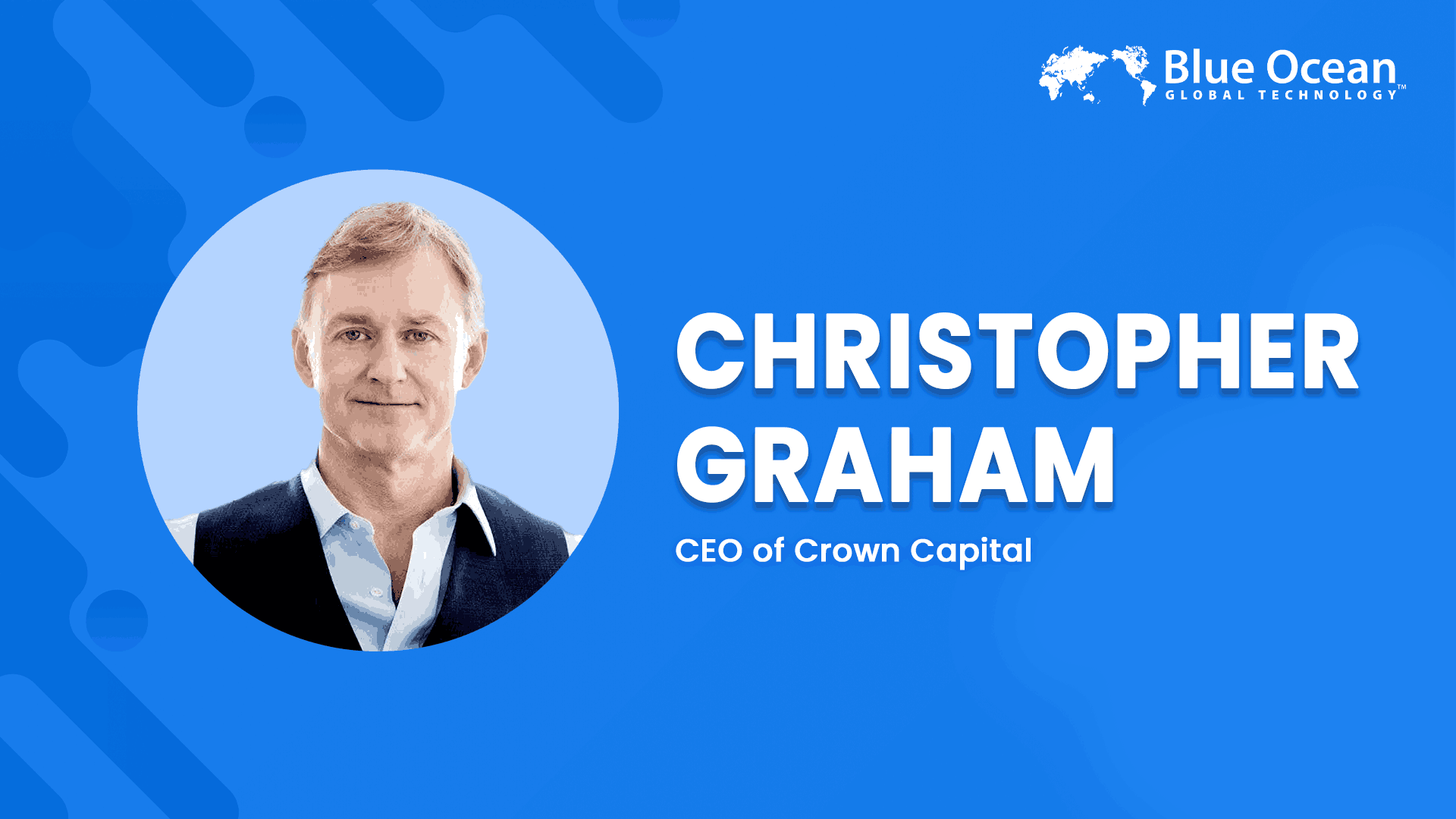
About Christopher Graham:

Christopher Graham founded Crown Capital in 2014 and currently oversees the firm’s investment strategy, capital-raising initiatives, and the delivery of strategic and operational guidance to portfolio-company leadership teams. Before establishing Crown Capital, he founded The Private Client Law Group, where his practice centered on sophisticated tax planning, business structuring, and wealth-preservation strategies for ultra-high-net-worth family offices. In his capacity as a Family Office Advisor, he counseled clients on the deployment of billions of dollars in global alternative investments.
Graham has been recognized on the Georgia Super Lawyers list for more than a decade and has earned distinction as a Five Star Wealth Manager. He holds a BBA in Accounting from the University of Michigan and a Juris Doctor from Wake Forest University. He is also a member of American Mensa, Beta Alpha Psi, and the Georgia and North Carolina state bars.
Blue Ocean: Could you tell us about your professional journey—what inspired you to pursue this industry?
Christopher Graham: I grew up in a trailer park in Detroit, but I excelled in mathematics and academics, which opened important opportunities for me. I went on to attend the University of Michigan for my undergraduate studies and later Wake Forest University for law school, concentrating on tax and accounting at both institutions.
After graduating, I joined Arthur Andersen, where I spent approximately six years during the 1990s. I was later recruited by a law firm to lead its advanced tax strategy group. My entire career has been rooted in the high-net-worth family office sector, beginning at Arthur Andersen and continuing through subsequent legal roles.
In the early 2000s, several of the families I advised began involving me in their business operations. I served on boards, assisted with operational challenges, managed projects, and acted in fractional COO and CFO capacities. Those experiences taught me how to quickly identify high-impact priorities and implement effective solutions — a foundation that ultimately evolved into what is now known as Crown OS.
Around 2006–2007, those same families asked me to begin sourcing direct private-equity investments for them. I identified opportunities aligned with an investment thesis shaped through years of collaboration, and they later asked me to manage those companies on their behalf. Between 2007 and 2012, this work matured, and by 2016, we formally established the Crown Capital platform. It began as an advisory group supporting several family offices in sourcing and managing investments. After exiting multiple deals and entering 2021 with meaningful liquidity, those investors encouraged me to create a formal fund, marking my transition from advisor to fund manager.
Blue Ocean: Which emerging trends in your industry most excite you?
Christopher Graham: In our industry, the most significant trend I am monitoring is the rapid advancement of artificial intelligence. I cannot yet determine whether it inspires excitement or unease, but its potential impact is unmistakable. For small businesses—the segment in which we invest—I believe AI will serve as a powerful equalizer.
At a company the size of Google, employing a $500,000-per-year HR director is easily justified, and the corresponding performance typically reflects that level of expertise. The cost is negligible relative to overall revenue, and there is no incentive to reduce it.
In contrast, for a small company, even a $150,000 HR director represents a substantial financial commitment, and the outcomes generally align with that lower compensation level. If AI enables a $150,000 HR director to perform at the level of a $500,000 executive, that represents a major transformation. Likewise, if we can hire an $80,000 employee and empower them to perform like a $150,000 one, the improvement is equally meaningful.
We anticipate that AI will strengthen our administrative, accounting, HR, facilities, and maintenance functions, enhancing performance across our operating expense categories. For us, AI has the potential to level the competitive landscape between large and small companies while meaningfully improving our net margins.
Blue Ocean: What do you believe is the key to your success, and how do you stay ahead in such a competitive environment?
Christopher Graham: The foundation of my success is continuous learning. I read extensively because I am naturally curious, and that curiosity is shared across our entire firm. Our discussions frequently extend well beyond private equity, touching on subjects such as physics, political theory, economic theory, system dynamics, and mathematics. This intellectual curiosity fundamentally shapes the way we work.
I typically read between fifty and seventy books each year. When people ask how I manage that volume, I explain that my focus is not on the number of books but on maintaining a disciplined habit—reading seventy pages each day. That consistent daily practice produces the annual total.
Remaining competitive requires a structured commitment to ongoing learning. Small, intentional actions accumulate over time, and I firmly believe in the power of compounding gains. It is this philosophy of incremental, disciplined improvement that I rely on every day.
Blue Ocean: What is something unique you offer to your investors and portfolio companies that sets Crown Capital apart in the private equity landscape?
Christopher Graham: What differentiates us most is our Crown OS. While many private equity firms concentrate primarily on sourcing deals, raising capital, and connecting the two, their operational involvement tends to be minimal—often limited to hiring managers they already know or relying on modest operational methods. In many cases, performance is driven largely by financial engineering and the use of leverage to execute transactions.
Our approach is fundamentally different. In our most recent exit, we achieved approximately a 90 percent IRR and a seven-times MOIC with a company that carried no debt. We have never used leverage in that business. There was no financial engineering. Instead, we implemented our Crown OS, and our team operated directly within the company alongside the existing management.
We train leadership teams on our system and equip them with a new framework for understanding and optimizing the business. The methodology is entirely our own—we do not rely on external consultants or third-party systems. It is our structured approach, applied by our team, layered on top of the foundation management has already built.
Our philosophy centers on systematic, mathematically grounded improvement, supported by clear measurement and a transparent path forward. That is our true differentiator. I do not see other private equity firms that are as operationally engaged or that deploy their internal talent in the same way we do.
Blue Ocean: In your experience, what qualities separate those who excel in their field from those who don’t?
Christopher Graham: I believe two qualities distinguish those who excel from those who do not. The first is genuine curiosity. I have always been motivated to understand my craft deeply and to solve problems thoughtfully. The second is a desire to add value and support the people around me.
During the legal phase of my career, I approached my work with two objectives: to provide exceptional service to my clients and to make my supervisor’s job easier. I consistently looked for ways to take work off his plate, which pushed me to broaden my skills. Taking on responsibilities from a senior attorney required me to learn quickly, and over time, that growth allowed me to assume even greater responsibilities. Ultimately, it contributed to my becoming one of the youngest partners and a significant revenue generator at the firm.
At Crown, we often emphasize that we are all part of a single system. Some individuals rely on us for deliverables, while we depend on others to perform their work effectively. When you view the organization through that lens, it becomes natural to do your best for those who count on you—and to expect the same in return. When everyone adopts that mindset, the entire system rises together.
Blue Ocean: How do you approach mentoring entrepreneurs and management teams across your portfolio companies?
Christopher Graham: I take a highly systematic and intentional approach to mentoring the entrepreneurs and management teams across our portfolio. Twice a year, we convene all executives in person, and I personally lead training sessions on key components of our operating system. Our most recent session focused on business mapping, a foundational tool we use to increase organizational throughput. We map the business, define role responsibilities, align them with the operations map, and evaluate the current state against the optimal state to close performance gaps over time.
In addition to these in-person sessions, we conduct remote training two to four times a year. Bringing all executives together—whether in the same room or on the same call—creates an environment where they can learn from one another and internalize the system in a supportive, collaborative setting. Many leaders in lower-middle-market companies have spent their entire careers within a single organization. Their expertise is rooted in practical experience rather than formal business theory from institutions like Wharton. When I introduce a structured system that they can implement within their own companies, it enables them to understand the business more holistically and with greater strategic clarity, ultimately elevating their capabilities. Over time, this approach drives meaningful transformation within the organizations we support.
Blue Ocean: What advice would you give to your younger self if you were starting your career in this multifaceted industry?
Christopher Graham: If I could offer my younger self advice, I would urge myself to think bigger, sooner. Private equity was a viable path much earlier in my career, but at the time I could not fully appreciate its potential. Expanding my perspective earlier would have accelerated my trajectory.
In the legal field, the turning point for me was finding a niche I genuinely enjoyed. I did not gravitate toward most areas of law, nor did I ever aspire to be a litigator. I was drawn to the analytical rigor of tax and mathematics, which naturally led me into systems thinking and process-driven work—areas that proved far more engaging. Once I found that niche, I never tired of parsing code sections or exploring nuanced ways to deliver value to clients.
The same principle applies in private equity. Our focus is not on assembling companies or leveraging debt to drive returns. Instead, we concentrate on operational improvement. That is the niche that both challenges us and sustains our interest. Ultimately, building a meaningful career requires identifying the part of the field that genuinely resonates with you—because that alignment is what enables sustained growth and long-term fulfillment.
Blue Ocean: What is something you are most grateful for, either professionally or personally?
Christopher Graham: I am grateful for many things. I find happiness every day and appreciate the simple gifts of being alive—the sunlight, the changing autumn leaves, and the presence of my family. Even in high-pressure moments, when something is going wrong within a company and significant capital is at risk, I remind myself that it is a privilege to be in a position where I can help. The situation may be stressful and the challenges may be complex, but having the responsibility—and the opportunity—to solve those problems is an honor in itself.

Blue Ocean: What’s one lesson in life that changed your perspective?
Christopher Graham: One lesson that fundamentally changed my perspective was realizing that I had been working tirelessly to scale a law firm in a way that was never going to be scalable. I remained on that path longer than I should have because I was determined to make it succeed. When I finally recognized that the model itself could not support the level of growth I envisioned, I had to step back, change course entirely, and fully commit to private equity.
I learned that you must be clear about what you want to achieve—and whether the field you are in can realistically support that degree of scale. Law can be a fulfilling career for those who want it, but it is inherently limited in scalability. You cannot scale people; you can only scale systems and processes.
Two books reinforced this realization: The Dip by Seth Godin and Who Gets What and Why by Alvin Roth. Both helped me understand which industries are structured for scale and which are not, and why it is critical to know where you fall on that spectrum. I came to see that we were not failing—we simply were not growing, and the model itself could never take me where I intended to go. Changing paths required courage, but it was necessary to reach the level I aspired to.
Blue Ocean: Is there a particular quote or piece of advice that has guided you through your career?
Christopher Graham: Two guiding principles have shaped my career. The first is to always do what is right for the business. At Crown, we view business through a purpose-driven lens. We consider what the world would look like if every individual were able to operate at their highest potential. If people had access to meaningful economic opportunity, many societal challenges would diminish, because individuals could rise to the level their capabilities truly support.
We believe opportunity is created from the bottom up through entrepreneurship—not through government intervention. Our responsibility is to build companies that can endure for generations and create long-term employment in the communities we serve. Doing so requires optimizing the business in the present and maintaining discipline around expenses, even when the decisions are difficult. The long-term health of the organization influences far more lives than any single short-term choice, and that reality guides our approach.
Blue Ocean: What hobbies or interests do you enjoy outside of work?
Christopher Graham: Outside of work, I spend most of my time reading. It is my primary pastime. I also play the piano, guitar, and other musical instruments, which provides a useful shift in focus and helps me maintain balance in my life.
Conclusion
Christopher Graham’s progression from tax law to private equity demonstrates how curiosity, adaptability, and systems thinking can meaningfully shape a career. By prioritizing operational enhancement over financial engineering, he built Crown Capital on a scalable model that empowers people through structure, clarity, and disciplined execution. His experience underscores three essential lessons: commit to continuous learning, choose a path capable of growing alongside your ambitions, and rely on systems that enable individuals to perform at their highest potential.
Do you have a personal or professional story that can inspire other people into becoming the best version of themselves?
You are welcome to share your journey with our audience.