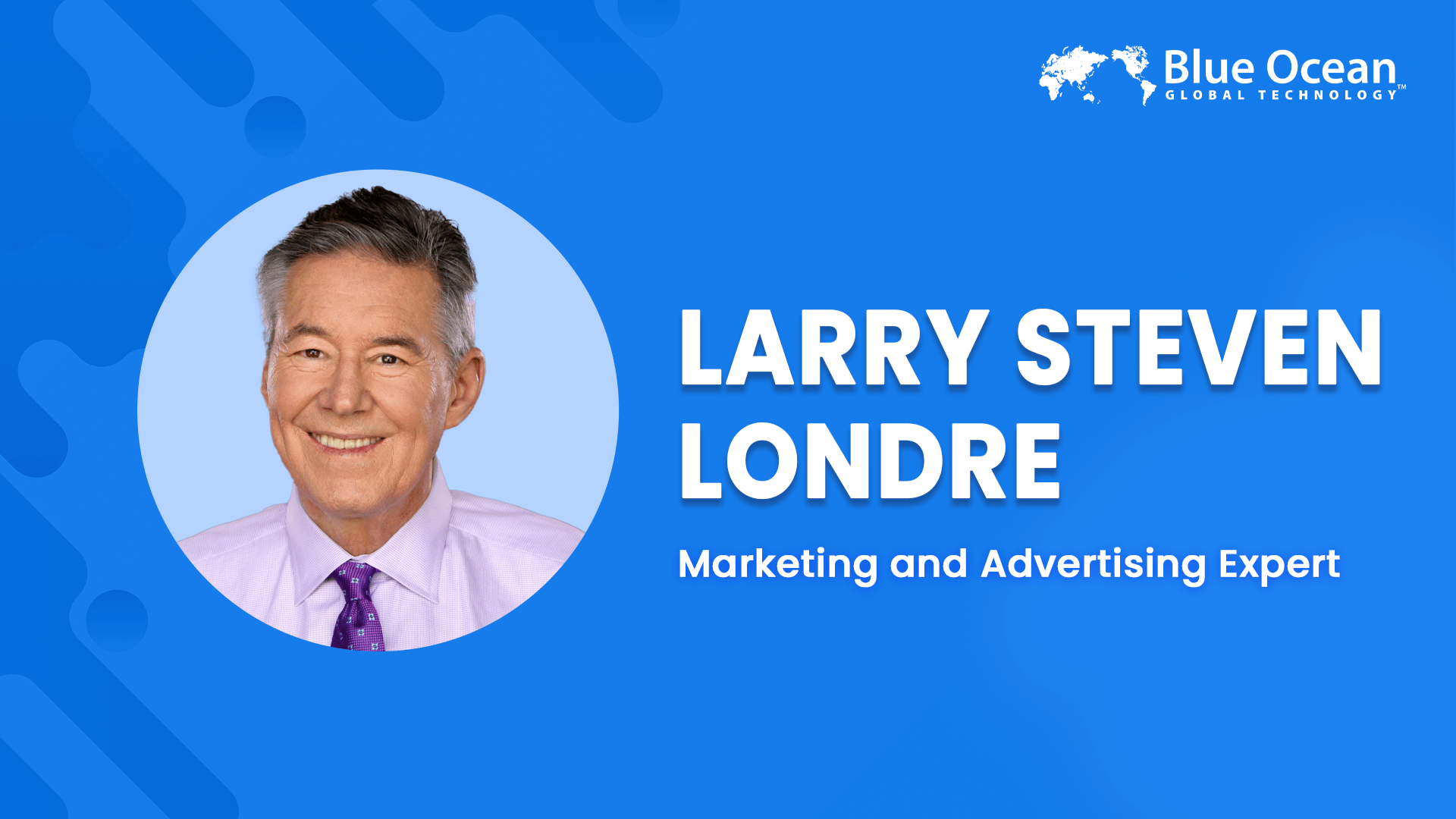
About Larry Steven Londre
Larry Steven Londre is a senior marketing, advertising, and media executive with extensive client and agency experience, including marketing management roles at DIRECTV, Walt Disney Productions, Grey Advertising-Worldwide, and The Music Center of Los Angeles. Plus his own firm Londre Marketing Consultants, LLC. A marketing, advertising forensic consultant, he has served as an expert witness in more than 90 cases, including multiple matters for the “People”. Since 1975, he has been actively involved with Ad Relief, supporting his colleagues in times of crisis. Larry has taught marketing, advertising, and global business strategies for over 50 years at USC, CSUN, Loyola Marymount, and Pepperdine, and has conducted seminars and workshops across the U.S. and internationally.
Blue Ocean: Tell us about your professional journey. What inspired you to pursue a career in marketing, and how did that eventually evolve to include expert witness work?
Larry Steven Londre: I stood out in several marketing classes at the University of Southern California (USC), which opened doors to opportunities. The Chair of the Marketing Department invited me to assist with his research projects and client work. For my first assignment, I conducted marketing research on giant subway-digging equipment and spent days gathering material at the library.
The next project involved studying the potential market for sports camps where young athletes and adults could train with “celebrity” coaches in football, basketball, or track and field. I visited 35 high schools across Southern California, interviewing principals, coaches, and football players and their parents. The client was a well-known USC wide receiver who would go on to have the first sports camp in Southern California.
Another time, a professor introduced me to a member of the Board of Directors at Security Pacific National Bank, which was purchased later by Bank of America. That led me to my first full-time position as a Marketing Officer at the bank. I pursued my MBA at night, graduating in the top 3–4% of my class. After that, I began teaching. I’ve taught 79 semesters, almost all at night or weekends roughly half in the MBA program and half at the undergraduate level, mentoring students while maintaining an active full-time professional life.
I eventually left Security Pacific to join Grey Advertising-Worldwide, one of the major agencies of its time. I worked on Bank of America, Southern California Edison, Vons Grocery, California Special Olympics, among others.
Through my firm, Londre Marketing Consultants, I led strategic marketing projects for major clients such as GE Capital, developing campaigns for multi-dwelling units and exploring innovative ways to deliver telephony and video services to apartment complexes and condominiums. Later, DIRECTV recruited me, where I played a key role in launching its satellite entertainment and sports programming across the United States.
I continued to teach one to three nights a week and conducted marketing seminars worldwide, in Hong Kong, Vietnam, Beijing, Cuba and Shanghai. My firm remains focused on marketing strategy, advertising, and communications consulting. In 2002, a couple of attorneys approached me to serve as an expert witness in marketing and advertising cases. Over the past 23 years, I have served as an expert witness or consultant in 100 cases, offering insights into marketing, advertising, and business practices.
Blue Ocean: What does a typical day look like for you?
Larry Steven Londre: My last twenty years of professional time have been divided into one-third consulting, one-third expert witness, and one-third teaching. I developed a presentation called “What is Marketing? What is Advertising?” These are not interchangeable words. I work on developing materials for law schools. I’m in my 14th year of working and presenting at Loyola Law School, Southwestern Law School, UCLA Law School, and USC Gould School of Law.

Blue Ocean: Which emerging marketing, advertising, or media trends excite you most?
Larry Steven Londre: One is on my website. I have a free-access paper that contains about 240 different examples of advertising and sales promotion, of which television is just one. I’ve been really interested in what’s called a retail media network (RMN). The retailers are much stronger than they used to be. Walmart Connects and Amazon Ads are part of that RMN. A typical supermarket has 30,000 to 40,000 items. Amazon has between 350 million and 600 million items, and 90% come from third-party sellers. In my 9Ps of marketing, “Partners” are one of the strongest. And so I like looking at partners, collaborations, alliances, and companies working together as a team.

Blue Ocean: Can you walk us through a particularly complex marketing or expert witness case you’ve handled and explain your strategy for approaching it?
Larry Steven Londre: I worked with three state attorneys general in California, Washington, and Illinois, as well as about a dozen city attorneys in California. These are elected positions in cities, including many in California, and I’ve actually worked on the RJR Master Tobacco Agreement.
In some cases, I helped remove products from the shelves of two major U.S. retailers: CVS and Walgreens. In this case, the defendant sold an over-the-counter product that can be found in a specific section of the drugstore. The opposing company and his attorneys argued that customers could easily consult pharmacists about the product’s use and ingredients, even though the product had been causing harm and fatalities. To test this claim, I conducted a field study in 100 pharmacies, visiting each in three different outfits—casual, semi-formal, and formal—to observe any differences in treatment. I approached pharmacists with 5–10 short questions about the product. The results showed that pharmacists were generally too busy to engage with customers purchasing over-the-counter items, focusing instead on prescription clients. Approximately 90% of pharmacists stated they had no time to discuss product ingredients, usage, or potential dangers, revealing that such consumer-pharmacist interactions were rare in practice.
I’m proud that it was one of the products I’ve helped get off store shelves because they were hurting people. I was creative in learning how to manage and ensure no one was harmed, which was very insightful.
Blue Ocean: You’ve earned a strong reputation. How do you and your team continue to stay ahead in the highly competitive industry?
Larry Steven Londre: I prefer hiring professionals I’ve worked with, former students, or individuals I’ve met through public service and charity organizations I’m involved in. At the University of Notre Dame, Jerome McCarthy introduced the concept of the “marketing mix,” which broke marketing down into Product, Price, Place, and Promotion. I’ve expanded on that idea over the years, developing my own framework of the nine Ps.
In addition to the original four P’s, I include Planning (or marketing research) and People, which I consider especially important in the digital age. I also add Partners, Presentation (or branding), and Passion—whether it’s the excitement of customers lining up for a new Apple product or the enthusiasm of employees who love their work.
I’ve gathered examples of each of these principles from my experiences across 105 countries where I’ve taught, worked, and conducted seminars. I only count countries where I’ve truly spent time—crossed the land, shared a meal, or engaged with people. For instance, when I return to Sicily for the third time, even though we’ll be there for 18 days, I won’t recount it because I’ve already been there.

Blue Ocean: What core values or principles do you believe every great professional should uphold, regardless of their practice area?
Larry Steven Londre: My first principle is to provide value and look beyond the initial problem. When companies believe they have one issue, it’s often just a symptom of something deeper. This ties into the “Passion” element of my nine Ps—when a team genuinely enjoys working together, that unity is far more valuable than a company that has simply “quit,” as one once admitted to me.
I developed the 9Ps through real-world experience. In one client experience, I was one of three consultants brought into a company. We didn’t know each other, and we spent over seven hours listening to executives describe their challenges. While they spoke, I divided an 8 1⁄2-by-14 sheet of paper into my nine categories or elements of my 9P’s and took detailed notes—listing problems, opportunities, and solutions for each.
By the end, I had the most comprehensive notes and the clearest solutions. I walked the executives through each issue, showing them practical steps and timelines for improvement. They appreciated my structured, solution-oriented thinking and offered me a six- to nine-month assignment.
That experience reinforced my belief in preparation, organization, and responsiveness—values I learned early on. As my parents taught me, being five minutes early means being on time. Even today, I keep that habit.
Blue Ocean: What distinct value do you bring to your clients, whether in driving strategic marketing initiatives or providing expert analysis in litigation?
Larry Steven Londre: I come up with unusual ways to solve problems. That mostly comes from experience and from working on so many different cases. I genuinely like investigation.
One of my best examples goes back to 2002, with one of the first attorneys I ever worked with. He was representing a plaintiff and had a particular premise. I offered him a different way of looking at the problem that he hadn’t considered. In that case, I went out and visited 24 architects, asking them a specific question or two. My results helped win him the case.
My approach is to look at the entire problem or opportunity and apply the Nine P’s of Marketing—then investigate it from maybe a thousand different angles.

Blue Ocean: What are some common misconceptions people have about Marketing, Advertising, or your role as an expert witness?
Larry Steven Londre: Not long ago, during a deposition, I made the point that marketing and advertising are not interchangeable words. The attorney questioning me actually said, “Well, I don’t know the difference between marketing and advertising.”
That moment told me he hadn’t done his research, and he certainly hadn’t looked at the free resources available on my website. I have over twenty pages outlining my framework, The Nine P’s of Marketing, and it’s all there for anyone to read.
When I lecture at law schools like Loyola School of Law, Southwestern, UCLA, and USC, I walk students through how the traditional four P’s evolved into the Nine P’s — and that advertising represents just one part of one “P.” I give and explain over 125 examples from the USA and around the world.
I even have a paper I share with graduate and undergraduate students that outlines this in depth, and I reference it frequently in my expert witness work.

Blue Ocean: How do you maintain emotional and psychological resilience when working on high-stakes campaigns or legal matters?
Larry Steven Londre: The first thing I thought of—and I do this during depositions—is simple: take a deep breath. Sometimes I’ll even drink more water during depositions, because it gives me a moment to think before responding.
But really, my resilience comes from loving what I do. I love marketing, consulting, advertising, teaching, and even expert witnessing. That passion fuels me and keeps me grounded.
I’ve also had the privilege of traveling to 105 countries, and I draw from those experiences in nearly every presentation I give. They remind me how people around the world approach challenges differently, and that perspective helps me stay balanced and curious rather than stressed.
For example, in Marseille, France, where people are not known to be that friendly, I saw a shop with a sign in English that read, “Your husband called. Buy anything that you want.” I noticed he was appealing to the “People” or potential customers in my nine Ps. Decades ago, French shopkeepers were known for being cold, but now, we were in France this year, tourism has shown them the power of friendliness, and it drives revenue and jobs.
Then, in Swaziland (now officially Eswatini), the King changed the country’s name, claiming that people confused it with Switzerland. I found that fascinating, and a bit misguided, because the change ended up confusing citizens, neighboring countries, manufacturers, exporters, importers, and even the UN. It’s an example of how ego-driven decisions can backfire, while others rooted in understanding the customer, like that shopkeeper in Marseille, can thrive. Those are two examples, I have plenty more in my consulting and presentations, that show how people try to either solve a problem or find a solution. One was brilliant, and the other one was, I would feel, probably naive.
Blue Ocean: What advice would you offer to aspiring professionals entering the profession today?
Larry Steven Londre: Just as I stood out in class, I always tell students that you can get interviews, but you have to make yourself known. Go talk to your professors. Call them, walk up after class, and pick their brains. They’re being paid to train you, and part of that responsibility is helping you find opportunities in the real world.
I’ve been part of several professional public service groups over the years, and for about 25 years, we placed more than 1,624 people into paid positions. I don’t believe, never have, in unpaid internships — only paid opportunities. Every student deserves that.
Beyond that, it’s all about networking and relationships — with teachers, classmates, neighbors, anyone who might open a door. But you also need to stay current. Keep up with digital tools and AI.

Blue Ocean: Is there a guiding principle, philosophy, or quote that has significantly influenced your career and life?
Larry Steven Londre: One of the first guiding principles that comes to mind is from Dale Carnegie’s How to Win Friends and Influence People. I’ve probably read that book fifteen times. Also my wife jokes that I ask too many questions when we’re out at social events, but I’ve always believed that asking questions is how you truly learn about people. If you’re going to win friends, or build clients or students, you have to listen, really listen.
I also live by the belief that it takes a team. Whether you’re in an agency, working with a client, or in a classroom, success depends on collaboration. You work with people, not against them. Partnership is one of the most powerful principles I teach, and your “partner” is one of the nine Ps.
There are also a few quotes that have guided me throughout my life. Winston Churchill once said, “There are no foreign lands; it is the traveler only who is foreign.” I love that because it’s such a smart way to remind us that perspective shapes everything. Sergio Zyman, the former marketing officer at Coca-Cola, once defined marketing as “selling more stuff to more people more often for more money to make more profit.” Peter Drucker, on the other hand, said that “the ultimate aim of marketing is to make selling superfluous by understanding the customer so well that the product sells itself.” I use this quote on my website, and recently in a presentation and in a report. And one last one is from St. Augustine: “The world is a book, and those who do not travel read only one page.” As someone who’s been to over 100 countries, that one feels personal.

Blue Ocean: What hobbies or interests do you enjoy outside of work?
Larry Steven Londre: I’ve got three big ones. First, traveling. I’ve visited 105 countries, and number 106 is coming up in January. Second, teaching. There isn’t a week or month that goes by that I’m not preparing a presentation for law schools, graduate or undergraduate programs, or even Rotary Clubs. And third, the Super Bowl commercials. Since 1984, for 41 years, I’ve analyzed every single Super Bowl TV spot. That’s around 2,748 ads. Each year, I watch them with a group of about 20 people, then present my findings to two to five different classes or groups the following week.
The evolution of those ads tells a story about marketing itself. For example, in the next Super Bowl, a 30-second spot will cost about $9 million, or $300,000 per second—and that doesn’t even include production, celebrity talent, or creative costs. I contend that one-third of the ads are great, one-third are average, and one-third are either poor or just plain bad. And history shows it—advertising managers and even agencies have lost their jobs over poorly received Super Bowl campaigns.

Conclusion
Larry Steven Londre’s career highlights lifelong learning, purpose-driven leadership, and a passion for both teaching and practice. From pioneering marketing strategies at global organizations to shaping minds in classrooms across continents, Londre has built a legacy defined by curiosity, collaboration, and integrity. His “Nine Ps of Marketing” framework embodies his belief that people, products, planning, and passion drive every successful endeavor. Whether consulting for Fortune 500 companies, testifying as an expert witness, or mentoring future professionals, Londre demonstrates that true marketing mastery lies in understanding people.
Do you have a personal or professional story that can inspire other people into becoming the best version of themselves?
You are welcome to share your journey with our audience.