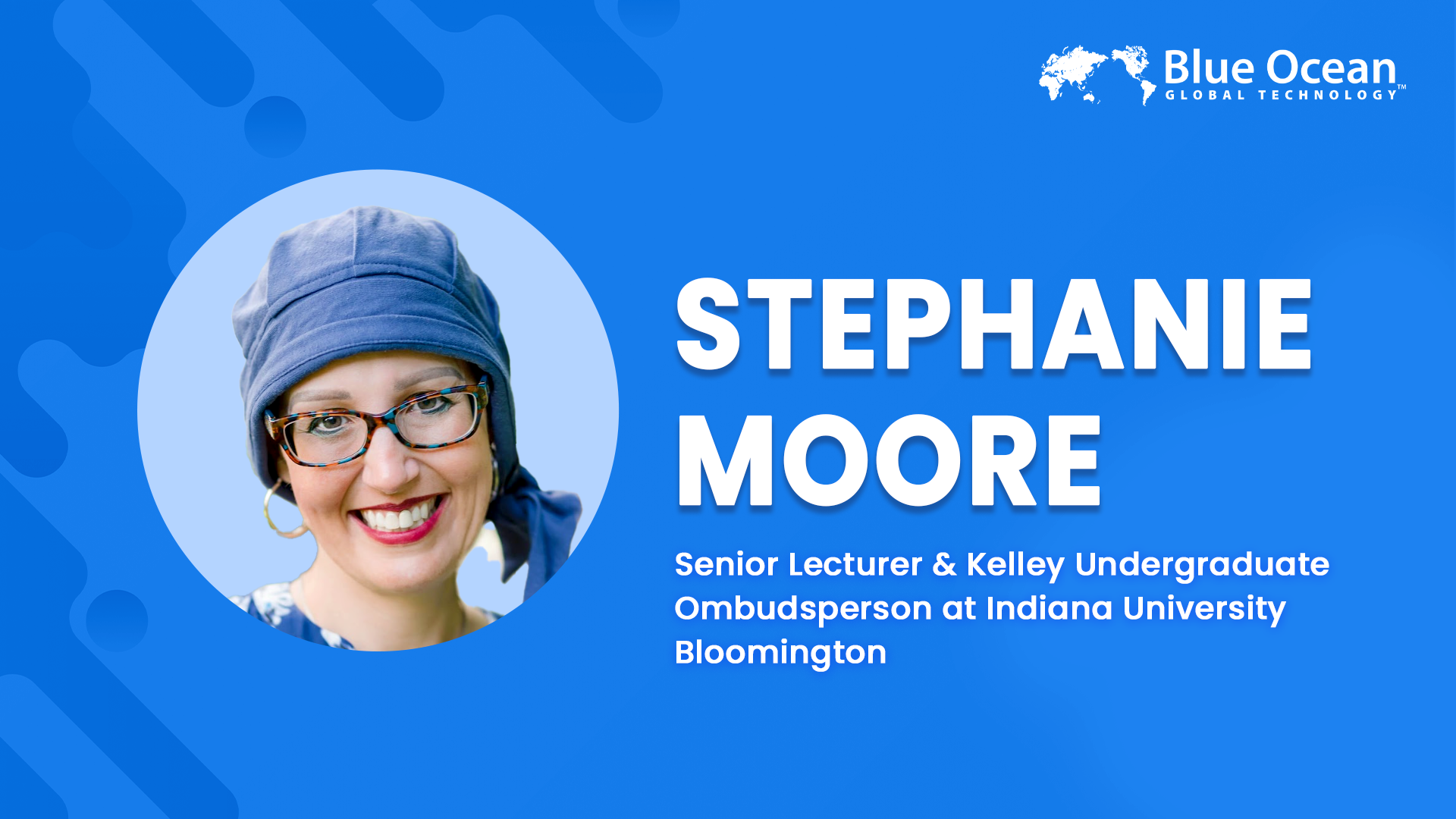
About Stephanie Moore

Stephanie Moore is a recognized leader at the Kelley School of Business and Indiana University Bloomington in ethical Artificial Intelligence. Moore’s courses are “critical thinking” courses – and are required for every Kelley student majoring in business law and ethics or for all LEAD (Law, Ethics, and Decision-Making) co-majors.
Moore graduated first in her class from Indiana University’s Robert H. McKinney School of Law. Prior to joining Kelley School of Business, Moore served for four years as a Federal Law Clerk for the Honorable Monroe G. McKay, United States Court of Appeals for the Tenth Circuit.
Student mentoring is central to Moore’s passion for teaching and service. She broadly and deeply impacts students grounded in pedagogical innovation and empathy. Moore is deeply immersed in the school and campus community, serving students as the Kelley Undergraduate Ombudsperson and as Champion of the Ethical AI Alliance Team at the Center of Women & Technology, among her many roles.
Moore also chairs the LEAD co-major committee – which oversees and coordinates LEAD initiatives. She has many awards and recognitions including Poets & Quants Favorite Business Professors of 2024, the Trustee’s Teaching Award, the Mumford Excellence in Extraordinary Teaching Award, and several Innovative Teaching Awards. The Kelley student body has additionally recognized her with several awards.
Blue Ocean: Could you tell us about your professional journey—what inspired you to pursue this path in law, education, and ethics?
Stephanie: I never set out to be a lawyer. I began as a voice major, dreaming of a music career, but soon realized that performing wasn’t the life I wanted to pursue professionally. After earning my degree in English and communications, I worked in advertising and sales for a few years, but found the work unfulfilling. I longed for something more meaningful, something that truly served others, so I attended law school. Two years in, I had my first child, and although I graduated at the top of my class, I faced the reality of balancing motherhood with a demanding career. When I told Judge Monroe McKay, whom I was set to clerk for, that I couldn’t leave my baby in childcare, he surprised me with compassion. He told me to bring my son to the chambers. For the next several years, I worked alongside him while raising my children, learning invaluable lessons about leadership, empathy, and the importance of placing people at the center of meaningful work.
After relocating and eventually raising four boys, I pursued different professional avenues, from mediation to student ethics, before discovering my true passion for teaching and mentorship. For the past decade, I’ve been teaching, leading a team of interns, and focusing my research on ethical AI. I also serve as an ombudsperson on campus. Teaching allows me to combine everything I care about: law, ethics, mentorship, and the belief that purpose and humanity should guide the work we do.
Blue Ocean: What does a typical day in your life look like?
Stephanie: A typical day for me is split between teaching, mentoring, and supporting students. I usually spend a few hours in the classroom, where I prefer to lead discussions rather than simply lecturing; it’s in those conversations that real learning happens. I also hold office hours to connect one-on-one with students and meet regularly with my lead intern, or sometimes my entire team, who work with me on ethical AI research projects.
Beyond teaching, I serve as ombudsperson for Kelly, for the business school’s undergraduates, which means I often meet with students navigating bias incidents or other challenges. That part of my role allows me to advocate for fairness and inclusion on campus. Of course, there are always administrative tasks to handle, though they’re far less fulfilling. My favorite part of the day will always be the direct teaching and mentorship that remind me why I chose this path.
Blue Ocean: Which emerging trends in business law, legal education, business ethics, or AI do you find most exciting right now?
Stephanie: I think the rise of generative AI is both incredibly exciting and deeply challenging. The pace of innovation in this space is remarkable, and it offers tremendous opportunities for business, education, and research. But with that excitement comes the responsibility to ask important questions: how do we use this technology well, and how do we ensure it aligns with ethical practices?
For me, the most compelling part of this trend is the chance to pair technological advancement with conversations about critical thinking, policy, and judgment. As we move forward, it’s essential to train students and professionals not just to adopt AI tools, but to do so thoughtfully, with an awareness of the risks as well as the possibilities. It’s an exciting frontier, but one that requires equal parts curiosity and caution.
Blue Ocean: What do you believe is the key to your success, and how do you stay ahead in such a competitive environment?
Stephanie: I believe the key to my success lies in maintaining a growth mindset. I never assume I’ve learned everything, so each day is a chance to grow. Every classroom, every semester, is a new environment where students also teach me, and I try to approach those experiences with openness and humility.
That mindset applies beyond teaching. Whether it’s critical thinking, decision-making, or advocacy, I know there’s always room to improve. I view every person I meet as someone who has something to offer, and that perspective keeps me learning, evolving, and moving forward in a competitive environment.
Blue Ocean: What do you think sets your approach apart when working with students or the academic and professional community?
Stephanie: What sets my approach apart is the intentional focus on building trust from the very beginning. In the first week of every course, I start with a lesson on civil discourse. I want students to understand that the classroom is not just about learning from me, but it’s about learning from each other.
By creating a foundation of trust and respect, students feel safe to share ideas, challenge perspectives, and engage more deeply. That structural emphasis on trust and open dialogue shapes the entire learning experience, and I believe it’s what truly differentiates my approach in both academic and professional settings.

Blue Ocean: In your experience, what qualities separate those who excel in their field from those who don’t?
Stephanie: In my experience, the people who don’t excel are often those who believe they already have all the answers. What truly separates those who grow is a willingness to ask questions, seek feedback, and learn from it. Feedback can be uncomfortable sometimes, poorly delivered, or sting in the moment, but it almost always contains something useful.
The key is developing the ability to accept feedback, sort through it objectively, and use what helps you improve while discarding the rest. I’ve learned to give myself space before revisiting feedback, so I can look at it with fresh eyes and less emotion. That mindset—staying open, reflective, and willing to grow—is what allows people to keep excelling, while others level out.
Blue Ocean: How do you approach mentoring or guiding those who look up to you?
Stephanie: I mentor students in different capacities: through my classes, in our co-major program, in my ombuds role, and with my team of interns. Therefore, I interact with them in both academic and personal contexts. They often come to me with career questions, like whether they should pursue law school or take a particular job, but also with personal struggles that weigh heavily on them. My role isn’t to act as a parent or a friend, but as a professional guide who creates a safe space for them to reflect and grow.
I’ve noticed that many students want someone else to make their decisions for them. It’s an instinct at this stage of life, but I don’t believe that serves them in the long run. My goal is not to hand out answers, but to encourage students to take full ownership of their choices. I help them critically think through what matters most to them, and how those priorities should shape their decisions.
That often comes back to values. I talk a lot about purpose and values in my classes because they serve as a compass. For me, family is my highest value, but for someone else it might be financial security, career advancement, or independence. Two people facing the same choice will make different decisions depending on what they value most, and that’s okay. By helping students uncover their own values and purpose, I give them the tools to make thoughtful, authentic decisions that align with the lives they want to build.
Blue Ocean: What advice would you give to your younger self as you were starting your career in this multifaceted field?
Stephanie: If I could give my younger self advice at the start of law school, it would be to not get lost in the competition. The environment can feel intense, with the grading curves, comparisons, and constant pressure to excel, but understanding that reality ahead of time helps you stay grounded. For me, law school was exciting and fun, but I know many students find it overwhelming. I often remind my students today that if they can manage the competitive culture in business school, they already have the resilience needed to succeed in law.
I’d also advise entering law school with clarity and purpose. A law degree is incredibly versatile and can open doors beyond practicing as an attorney, but it’s not something to pursue just because you don’t know what else to do. Taking time to work, reflect, and consider your goals can make the experience far more meaningful and less overwhelming. Ultimately, law school is most rewarding when approached with intention.

Blue Ocean: What is something you are most grateful for, either professionally or personally?
Stephanie: I am most grateful for my family. My husband and our four boys have always kept me grounded, no matter how busy or demanding my professional journey has been, and their presence reminds me of what truly matters beyond the classroom or career milestones.
Blue Ocean: What’s one lesson in life that changed your perspective?
Stephanie: One of the biggest lessons that changed my perspective came while working at the 10th Circuit Court of Appeals. Judge McKay created a work environment that prioritized people. When I had my baby, he told me to bring him to chambers so I could both work and care for my child, which was a concept that felt radical at the time. Then, remote work or flexible schedules were uncommon, and he showed me that great leadership isn’t about rigid rules but about empathy, trust, and letting people thrive in their own way. That lesson completely reshaped how I think about leadership and management.
The other shift came from the cases themselves. Growing up, I believed the law worked equally for everyone. But working within the court made me realize that access to justice is not the same for all, and privilege plays a big role in outcomes. That was an eye-opening and humbling experience for me, one I couldn’t have learned in a classroom. Seeing the system up close gave me a deeper understanding of inequities in the law and instilled in me a commitment to fairness and advocacy that has guided my career ever since.

Blue Ocean: Is there a particular quote or piece of advice that has guided you through your career?
Stephanie: Judge McKay always said, “Choose luck every time”. At first, it might seem simple, but it is quite profound because a lot of people seem to think our success is solely the result of our decisions and hard work, and while those matter, luck plays a bigger role than most of us admit. Being in the right place at the right time, meeting the right people, or simply having doors open unexpectedly can change everything.
Blue Ocean: What hobbies or interests help you maintain a balanced lifestyle outside of work?
Stephanie: I love to travel. So that’s probably my biggest hobby. I love spending time with my kids, and I enjoy watching sports. I love taking walks and reading as well.
Conclusion
Professor Stephanie M. H. Moore’s journey is a testament to the power of purpose, resilience, and value-driven leadership. From her early experiences balancing motherhood and a legal career to her current role as a teacher, mentor, and advocate, she embodies the belief that success is not just about professional achievements but about the lives we impact along the way. Her story reminds us that empathy, continuous growth, and integrity are what truly define meaningful work and lasting influence.
Do you have a personal or professional story that can inspire other people into becoming the best version of themselves?
You are welcome to share your journey with our audience.