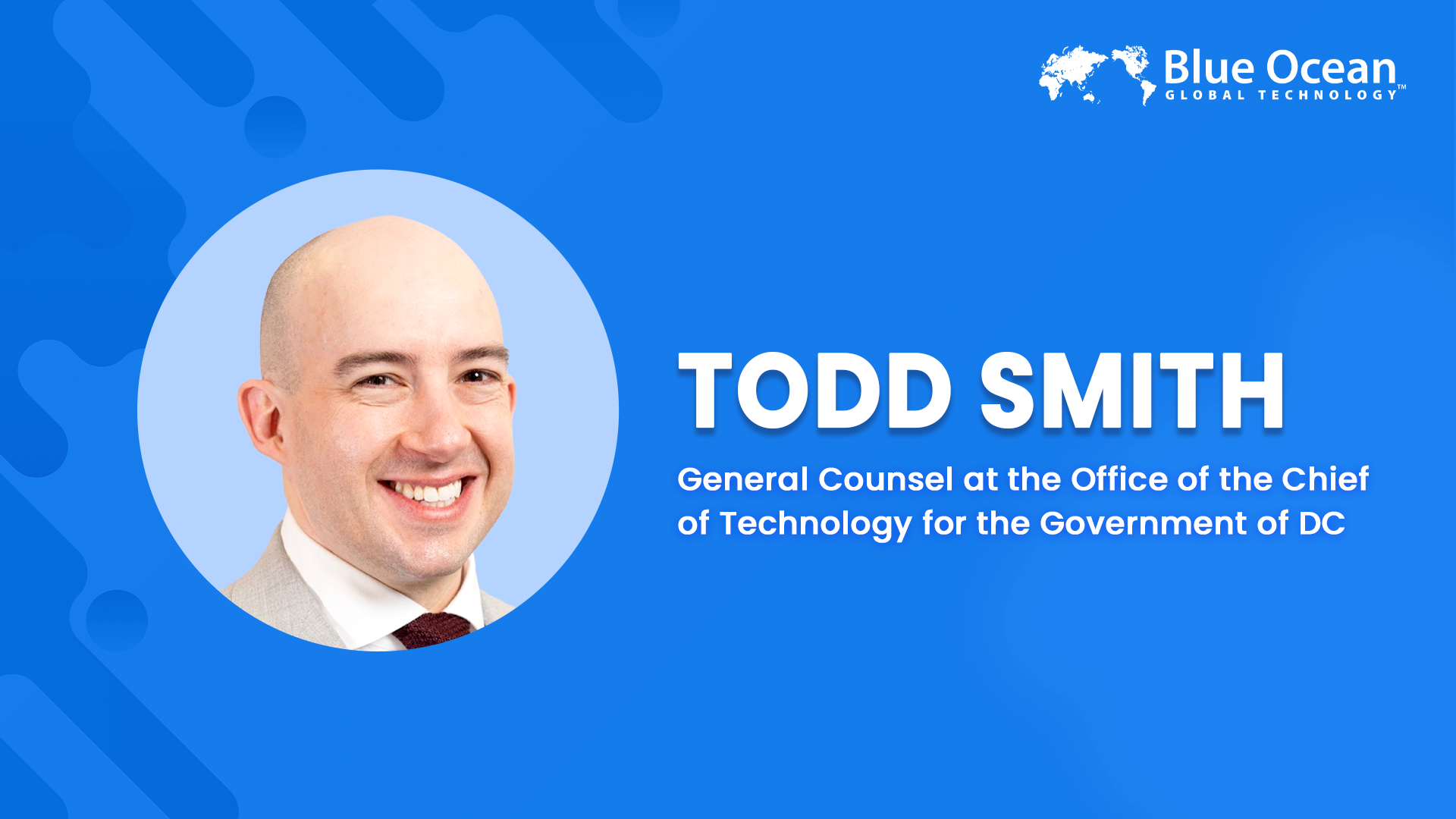
About Todd Smith

Todd Smith is the General Counsel for the District of Columbia’s Office of the Chief Technology Officer (OCTO), where he advises on complex legal, strategic, and governance issues at the intersection of law and technology. After graduating from law school, he began his career as a fellow in the DC Attorney General’s Office, transitioned into Big Law focusing on finance litigation, and later returned to public service as General Counsel for the District’s Department of Forensic Sciences, overseeing legal matters for DC’s forensic and public health laboratories.
Blue Ocean: Could you tell us about your professional journey—what led you to your current role as General Counsel at the Office of the Chief Technology Officer (OCTO) for the Government of the District of Columbia?
Todd Smith: After graduating from law school, I began my career with a fellowship in the DC AG’s office. After that, I transitioned into Big Law, where I spent a few years focusing on finance litigation. I returned to government and served as the General Counsel for the District of Columbia’s Department of Forensic Sciences, which includes DC’s forensics labs and public health labs, then joined OCTO, DC’s technology agency, where I serve as General Counsel today.
Blue Ocean: What does a typical day look like for you?
Todd Smith: It looks like ordinary in-house legal work. Occasionally, unusual or complex issues land on my desk that I need to manage directly, which is typical for a mid-sized GC role.
The job exists on three levels: doing individual contributor work, overseeing a team of attorneys, and serving as a senior strategist alongside the rest of the executive leadership. Outside of work, it’s the usual mix of exercise, books, cooking, and other hobbies.
Blue Ocean: Technology in government evolves rapidly. Which emerging legal or ethical challenges in this space most capture your attention today?
Todd Smith: The most interesting development in law and technology right now, to me, is that we’re being forced to think more critically about the concept of agency in two senses.
First, there’s agency in the broad, philosophical sense: whether something can act as an agent in an environment, taking in information, processing it, and producing meaningful actions. This first sense sometimes becomes entangled with ideas of sentience or selfhood and other complicating factors. Second, there’s agency in the legal sense: the relationship in which one party acts on behalf of another, with fiduciary duties to a principal that govern that delegation of authority.
Much of the discussion I see in this area strikes me as deeply misinformed. It will be interesting to see whether we succeed in making sense of, or reconciling, these two distinct conceptions of agency.
Blue Ocean: You’ve built a career at the crossroads of law, innovation, and governance. What do you think is most unique about your approach to solving problems and serving the public?
Todd Smith: If you do a good job at whatever you do, your work naturally serves the public. Every role comes with new challenges, and if you approach them thoughtfully, try to understand them meaningfully, and craft effective, practical solutions, you inevitably contribute to the public good. We are the public; none of us exists outside it. So when we talk about “public service,” we’re really describing the social environment we all help shape.
My approach to solving problems is fundamentally conflict-based. Conflict is a good thing. There’s a philosopher from the 18th century, Thomas Malthus, who argued that if human beings were no longer confronted with challenges or sources of struggle, all human virtue would disappear.
Even in a cooperative setting, conflict is valuable. I don’t treat conflict as something negative. I see it as the catalyst that forces us to think, refine ideas, and take action. There’s always a push, a spur, that drives progress. It refines perspectives, exposes weaknesses in ideas, and pushes us toward better solutions.

Blue Ocean: How do you approach mentoring or guiding those who look up to you?
Todd Smith: I’ve been teaching and mentoring for a while, and it started outside of the legal profession. Since 1996, I have been boxing for most of my life, and the first thing I taught other people was boxing. From there, I began teaching all kinds of skills in more structured settings simply because I enjoy it. Teaching is a great way to connect.
Over time, my experience teaching, tutoring, and mentoring has helped me learn to keep the focus on the mentee or student. If I had to give general advice to anyone trying to become a more effective mentor, it would be to ask more questions. Don’t think of your role as centering on transmitting information. It centers on the other person’s understanding as it develops in their own head.
If you accept that premise, think of your task as the cultivation of environments where the other person can grow spontaneously. When teaching or mentoring, if I’ve planned well, I usually find that within a short time, I’m doing little more than offering targeted advice and plenty of encouragement. And people really do need encouragement. That varies across historical and cultural contexts, of course. But today, I think most people benefit from active, consistent reinforcement as they develop.
Another important part of mentoring is crisis management. Early on, people are more vulnerable, whether they’re learning a new skill, building confidence, or navigating the professional world. In those moments, a mentor often needs to be available as a resource to help stabilize the situation and guide them through whatever unexpected difficulty arises. That kind of support can be invaluable to their long-term growth.
So, in my experience, effective mentoring is really about centering around the other person, creating the conditions for their success, offering genuine encouragement, and blunting the sting of major reversals.
Blue Ocean: You’ve expressed a deep appreciation for ancient history and figures like Scipio Africanus and Julius Caesar. What draws you to that era, and what do you find most fascinating about its people and events?
Todd Smith: My reading interests are broad, but those figures come up often because they’re uniquely important in human history. Take Scipio Africanus, for example. While Romulus is the mythological founder of the city of Rome, Scipio is a fully attested historical person, and more than anyone else, the father of Rome as a global power.
In his twenties, Scipio emerged at a moment of crisis during the Second Punic War, when Rome was reeling from catastrophe. Stepping into a leadership role that others avoided, Scipio reversed Rome’s fortunes by reconquering the Iberian Peninsula, carrying the war into North Africa, and decisively defeating Hannibal at the Battle of Zama. His subsequent military success in support of his brother Scipio Asiaticus in Greece helped secure Rome’s complete dominance of the Mediterranean. This established a norm still important today, where we think of citizens bearing all the responsibilities of a nation directly, rather than paying or pressing others into service to fight their wars, as in Carthage, or to undergird their economy, as in Sparta.
And Caesar’s the father of Europe. He dragged the Gauls and others from Celtic superstition into a world of law, commerce, and clean drinking water. That’s why I’m so interested in the classical period: it’s where our modern ideas of law and society were born.

Blue Ocean: As someone deeply passionate about history, particularly the Roman era, do you see any parallels between ancient governance and modern leadership?
Todd Smith: Yes. One of the reasons I enjoy studying the Roman Republic is that, in many ways, it resembles our government more than most modern systems do, and it’s very well documented.
Consider the Catilinarian conspiracy. We have the speeches delivered by Cato and Caesar on the fate of those conspirators who remained in Rome and faced arrest. Although they were ultimately executed, Caesar argued for leniency, insisting that even if the conspirators deserved punishment, the Republic should not compromise its own dignity by imposing too harsh a penalty. People make the same rhetorical arguments today.
And their laws were very well written, even by modern standards. A minor first-century Roman named Frontinus, tasked with overseeing the administration of the Roman aqueducts, judged his predecessor’s recordkeeping so harshly that he began his tenure with a full audit of the aqueducts and drafted a proposed law to remedy lax enforcement and metering. His recommendations are more or less indistinguishable from modern administrative law, including safe-harbor provisions for those who had been underpaying, if they voluntarily came into compliance within a given period of time.
You can see the impact at the Constitutional Convention—classical texts, the Bible, and Enlightenment era thinkers make up almost all of the Founders’ references. The legal and political reasoning that animated debates in the Roman Senate reappears in Philadelphia in 1787 and continues to echo in our legal system today.

Blue Ocean: How does your appreciation for history shape your worldview or even influence how you approach your work in law and technology today?
Todd Smith: Our perspective becomes very limited if we only talk to people like ourselves and read work produced by those who share our own values. To overcome an inherent temporal bias, we have to look backward.
If you want to control for any broad influence, whether that’s political, religious, or cultural, you generally have to reach back into the past to see how humans thought about a thing before that influence arose. Those records exist. Reading original historical sources reveals value systems that diverge from the assumptions we inherit in the 21st century. Edward Gibbon makes a related point in The Decline and Fall, that one of the best ways to understand someone is to examine the sources that shaped them. History helps us better understand the world we’ve received.

Conclusion
Todd Smith’s deep engagement with history influences his perspective on the contemporary world. By studying the intellectual foundations that shaped past societies, he draws valuable insights into the origins of modern legal principles, public policy debates, and worldviews.
Do you have a personal or professional story that can inspire other people into becoming the best version of themselves?
You are welcome to share your journey with our audience.